


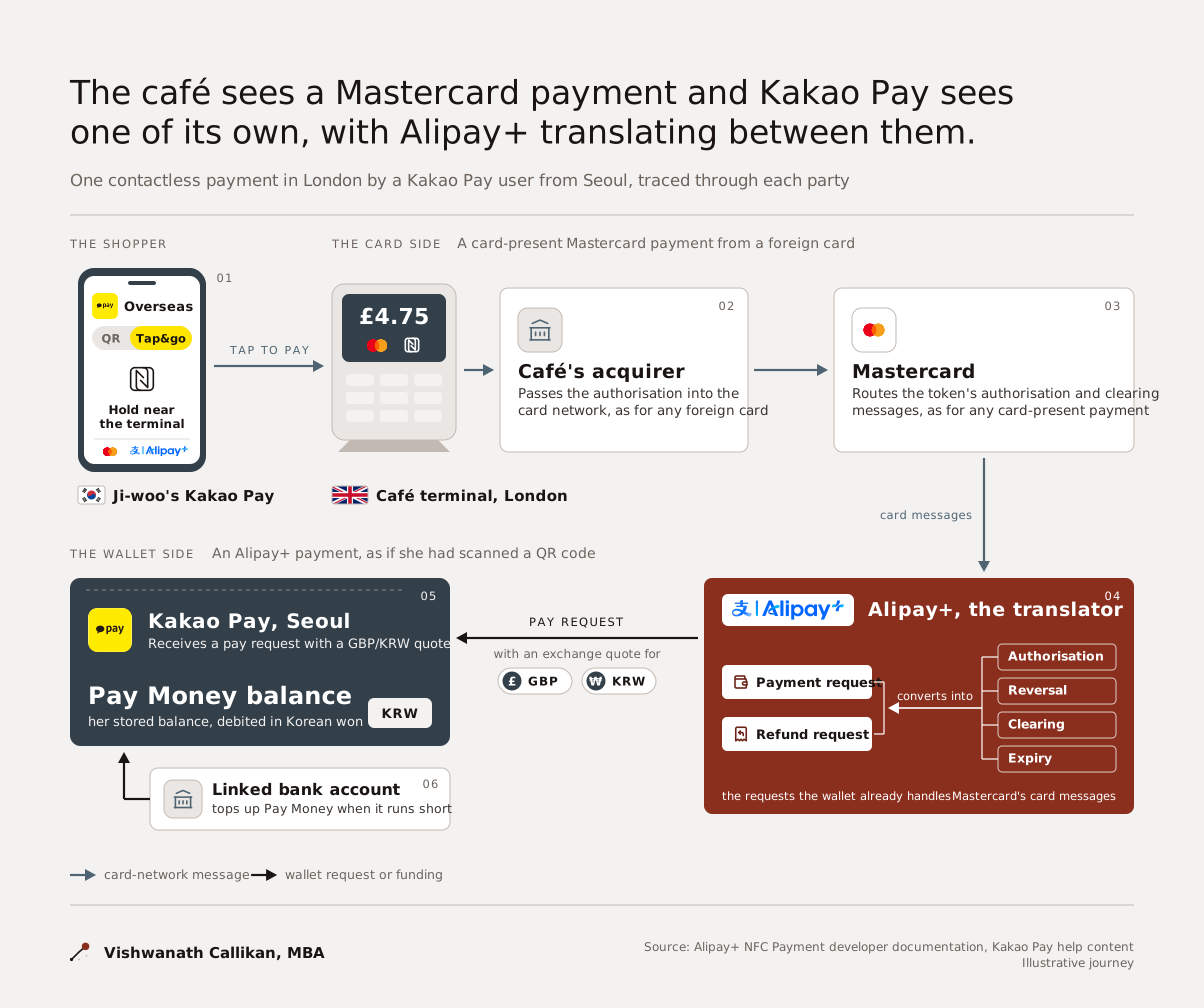
Take Ji-woo, a Kakao Pay user from Seoul, on holiday in London. She orders a matcha latte at a café in Soho while out shopping with her friends and seeing the sights. She holds her Samsung phone to the contactless terminal, pays and walks out savouring her drink.
Behind the scenes, the café’s acquirer sees an ordinary Mastercard contactless payment from a foreign card and passes it into the network like any other. Back in Seoul, however, Kakao Pay sees something else entirely. It receives the same kind of payment request it would get if she’d scanned a QR code, carrying an exchange quote for the pound-to-won (GBP/KRW) pair, and it debits her Kakao Pay Money balance, topping it up from her linked bank account if the balance runs short. Granted, Ji-woo is a figment of my fertile imagination, but the way her payment works is documented, and it has been live for Kakao Pay’s Android users since September 2025.
Mastercard packaged that journey on the 10th of September as Wallet Pay, a portfolio for digital wallets covering contactless, quick response (QR) code and online payments. The launch partners include Alipay+ and its partner wallets AlipayHK, Clip, GCash, Kakao Pay, TNG eWallet and TrueMoney, alongside Mercado Pago, TenPay Global, MTN, Axian, CRED and DaviPlata. John Adams at American Banker quoted TD Cowen describing Mastercard as the “interoperability acceptance layer”, and Arthur Bedel’s post on LinkedIn put it as Mastercard building the rails and every wallet plugging in. As far as it goes, that’s right, although it leaves open which party, if any, has to become a card issuer.
For me though, the key distillation is this. When a wallet user travels, the payment takes whatever form the destination already accepts, and the user’s account at home still pays for it as they’re accustomed. Mastercard’s part is to be that form in the countries that run on cards. The wallet stays the account that is debited. It still holds the balance or the line of credit the purchase draws on, it’s the party the currency conversion is quoted to, and the transaction and the customer stay in its app.
One note on scope. Wallet Pay covers online payments too, but this article is about the point of sale, because that’s where the mechanism is new. When Ji-woo buys from a UK website that offers Alipay+, she’s redirected to her wallet app to approve the payment, and no card credential is involved. The Mastercard token behind her contactless payment is documented only for a contactless terminal at the point of sale.
Alipay+ wallets were paying on Mastercard terminals a year before Wallet Pay
In April 2025, the Chinese tech press reported that mainland Alipay was testing an overseas near-field communication (NFC) payment on Android, funded from the Alipay balance, the Yu’e Bao money-market fund or Huabei, Ant’s consumer credit line, but not from linked bank cards. AlipayHK launched tap to pay with Mastercard on Android in July 2025. GCash users could pay this way abroad from August 2025, and Kakao Pay followed in September under the name Tap&go, on Android first, with an iPhone rollout planned for later. On the 1st of September 2026, AlipayHK went a step further by launching its own virtual Mastercard in Apple Wallet for its users in Hong Kong.
So the 10th of September mostly put one name, one brand and one commercial conversation around things Mastercard was already offering separately: the Alipay+ tap to pay, card programmes that wallets issue themselves, transfers through Mastercard Move, and Pay Local, which lets visiting cardholders pay through local wallets. For me, the launch matters because it packages and formalises this avenue within cross-border payments and global commerce enablement.
In the card countries, Mastercard plays the part national QR systems play for Alipay+ in Asia
To see why Alipay+ needed Mastercard, you have to look at how it reached merchants before. Alipay+ can be thought of as Ant International’s gateway for foreign wallets. In much of Asia it didn’t have to sign merchants one at a time, because it connected to national QR payment systems, which is Ant International’s own term for the shared QR schemes that countries such as Malaysia (DuitNow), Korea (ZeroPay), Thailand (PromptPay) and Indonesia (QRIS) have built. By its own count, it now links more than ten of them. Put simply, a GCash user in Seoul can scan a ZeroPay code, and the shop never needs to know GCash exists.
Europe, North America and Australia have no equivalent for Alipay+ to plug into, so its merchant network there was built through acquirers, largely merchant by merchant. In January 2025, Alipay+ counted more than 400,000 merchants across Europe, compared with more than 2 million in Korea, where ZeroPay did the work. On Alipay+’s NFC page, AlipayHK says its tap to pay is particularly convenient in Europe, the United States, Australia and New Zealand, where contactless payment is widely adopted, all of them places where Alipay+ had no national QR system to lean on.
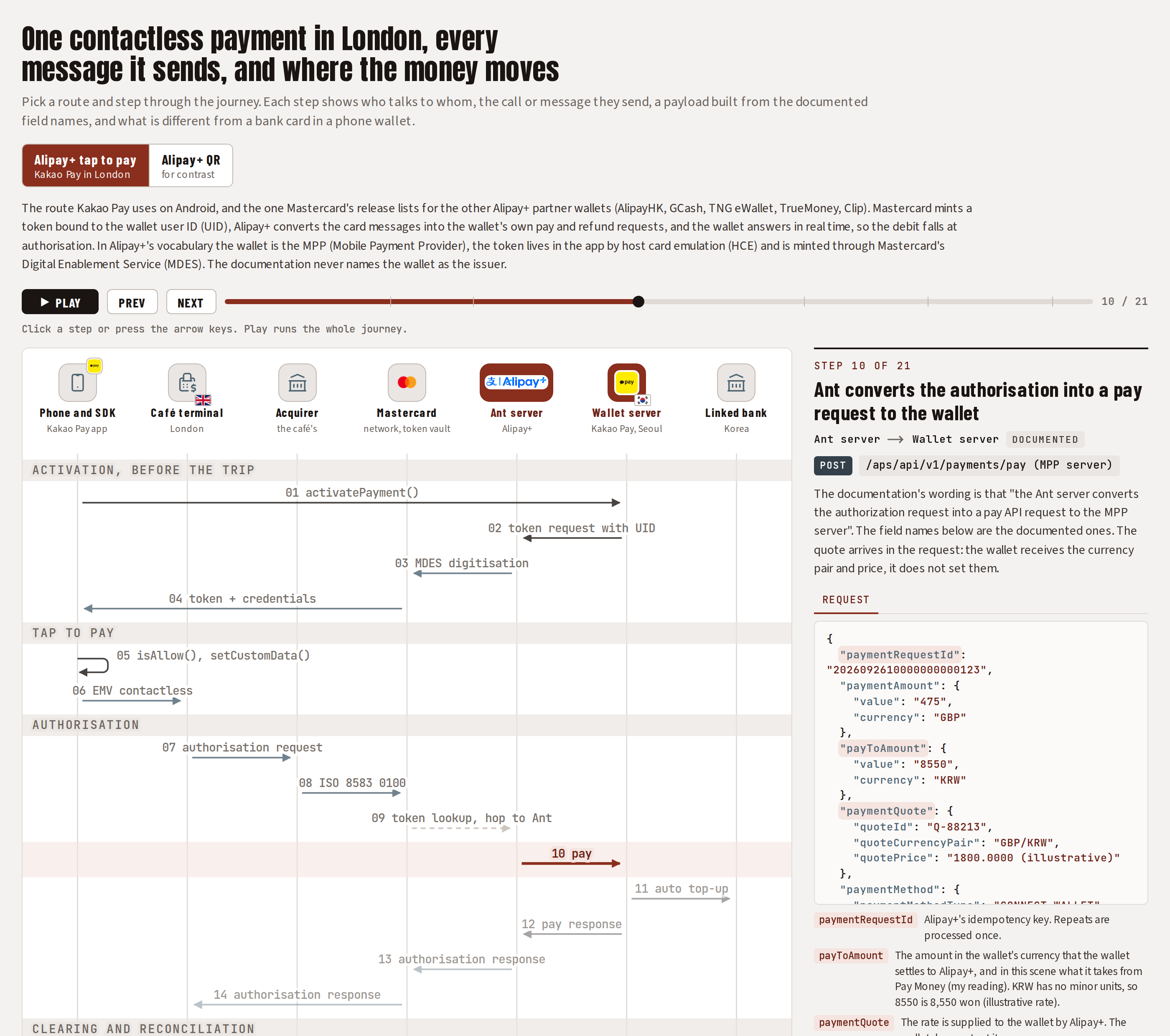
So how does a wallet that has never issued a card pay on a card network? Well, Alipay+’s developer documentation is quite clear about it. When the user switches the service on, Mastercard generates a payment token and binds it to the user’s wallet ID. The Alipay+ software inside the wallet app stores that token and presents it to the terminal through host card emulation (HCE), which lets a phone app act as a contactless card in software. When Mastercard routes the authorisation request to Alipay+, Alipay+ converts Mastercard’s authorisation, reversal, clearing and expiry messages into the payment and refund requests the wallet already handles as an Alipay+ partner. From the merchant’s side, the transaction is a card-present Mastercard payment throughout, while the wallet only ever sees an Alipay+ payment.
An issuer of record must still exist somewhere in the chain, because every Mastercard token maps to an account on a licensed issuer’s books. The documentation I’ve read doesn’t name that issuer, but it does make clear, indirectly, that the wallet isn’t asked to become one. The wallet’s own data is passed “through to the card issuer”, a separate party, and Mastercard sends the authorisation to Ant rather than to the wallet. The merchant didn’t have to change anything, and the wallet didn’t have to become a card issuer, and that’s what the partnership sells.
This is where I’d like to offer a bit of nuance. Some of the most shared LinkedIn commentary has described Wallet Pay as turning wallet providers into issuers of Mastercard credentials. That holds for the issuing route, where a wallet runs its own card programme, as AlipayHK now does with its virtual card on the iPhone. It doesn’t hold for the Alipay+ tap-to-pay route on Android, where the wallet issues nothing and the token Mastercard generates is bound to the wallet user’s ID. The distinction matters for two reasons. It decides who is asked to become a regulated card issuer, which on this route is nobody new, and it decides which party the shopper deals with when something goes wrong. Fig. 1 puts the two views of Ji-woo’s payment side by side.
If you want the same sequence message by message, Fig. 2 traces it party by party. Kakao Pay answers one pay call while Ji-woo is at the terminal. After that, anything the card side does later, such as a reversal or a partial clearing, reaches Seoul only as a refund or a cancellation, while Ant squares Mastercard’s clearing against what has been paid.
Android came first because Apple doesn’t allow the kind of software these wallets pay with
Coming back to those launch dates, every one of the Alipay+ tap-to-pay launches was Android only, and Kakao Pay’s help page still describes Tap&go as an Android-only service. You might assume that’s demographics, and Android does lead in the home markets of the six Asian wallets. On StatCounter’s figures for August 2026, which measure web page views rather than devices, Android had about 86% of mobile traffic in the Philippines, 71% in mainland China, 64% in South Korea and Thailand, 54% in Malaysia and 52% in Hong Kong. That would explain doing Android first. It doesn’t explain Hong Kong, where the split is close to even, and AlipayHK still launched on Android only.
The better explanation is technical, and it sits with Apple. Since Android 4.4 in 2013, any Android app has been able to act as a contactless card through host card emulation, with no agreement with Google and no fee to it, and the Alipay+ software development kit (SDK) is exactly that kind of HCE component. Apple offers an app two routes of its own to the terminal, and neither fits. Its HCE route, opened in 2024 under commitments to the European Commission, is limited to users with an Apple Account registered in the European Economic Area and to developers established there, so Kakao Pay doesn’t qualify, in London or anywhere else. Its secure-element route, the NFC & SE Platform, needs an agreement with Apple that carries fees, a developer established in an eligible territory and an app for users based there. Hong Kong and Malaysia are on that list, but South Korea, the Philippines, Thailand and mainland China aren’t.
So on an iPhone, a wallet from Korea, the Philippines, Thailand or mainland China has no route of its own to the terminal, and even in Hong Kong and Malaysia the route Apple offers runs through its own secure element and terms rather than the HCE software the Alipay+ SDK uses. AlipayHK took the issuing route instead, with a virtual Mastercard in Apple Wallet, and for me that’s consistent with the constraint being Apple’s rather than a choice the wallets made. It also shows the limit of the Alipay+ tap-to-pay route. Where iPhones carry a third or more of mobile web traffic (36% in Korea, 48% in Hong Kong), it leaves a large minority of a wallet’s users without tap to pay, and the way round it runs back through a card programme.
The wallet stays the account that pays, and Mastercard earns a cross-border fee
If you follow Ji-woo’s matcha through to the end, each party keeps something different.
The wallet remains the account that pays. Kakao Pay debits its own stored balance, topped up from the customer’s bank, and mainland Alipay’s test could draw on Huabei, so a Chinese traveller could spend Ant’s credit on a Mastercard terminal without ever being issued a Mastercard. What the traveller pays for the currency conversion isn’t published as a figure. However, Kakao Pay’s own FAQ says the rate it shows already includes its payment partner’s fee, so the cost sits inside the rate.
By customer-relationship primacy, I mean being the app the customer opens to pay, to see what she paid and to be rewarded for it, and on that score Kakao Pay keeps it all. The payment lands in its own history with the rate beside it, and at launch it rewarded a user’s first overseas contactless payment with points.
Mastercard, meanwhile, earns a cross-border fee on a payment Kakao Pay still funds, and cross-border fees are one of its faster-growing revenue lines. In the fourth quarter of 2025, Mastercard’s cross-border assessments, measured before rebates and incentives, were $3.27bn, up 21% on the year, while net revenue for the quarter grew 18% to $8.81bn. A traveller paying through Alipay+ QR in Europe, or in cash, contributes nothing to that line. The same traveller paying by tap to pay through an Alipay+ partner wallet almost certainly does, since the issuer of record is very unlikely to sit in the merchant’s country. In fairness, if she’d paid with one of her own cards from Seoul, that payment would have been cross-border too, so some of what Mastercard gains is card spend that might otherwise have gone to Visa or another network.
On published prices, tap to pay needn’t cost a London merchant more than Alipay+ QR
That leaves the merchant. One that used to take a Korean traveller through Alipay+ QR now takes the same shopper as a foreign Mastercard, and the obvious worry is that this costs it more. On the prices anyone publishes, it needn’t.
Adyen is the one acquirer I found that publishes both prices in the UK. Its pricing page charges every method the same fixed processing fee, 11p in the UK, and on top of that its Alipay+ page lists 3% of the ticket. A Mastercard costs 0.60% plus the card’s interchange and scheme fees passed through at cost, which is what interchange-plus-plus (IC++) pricing means. On a £20 purchase in a museum shop, that comes to 71p for Alipay+, against 23p for the card before interchange and scheme fees. The interchange and scheme fees on Ji-woo’s payment are the numbers nobody publishes, because they depend on an issuer of record nobody names. The UK’s caps cover only domestic consumer transactions, and the commitments Mastercard gave the European Commission, which cap interchange on consumer cards issued outside the European Economic Area at 0.2% for debit and 0.3% for credit when the card is present, apply only to merchants in the EEA.
At those levels, the card would cost the merchant between about 28p and 49p, depending on where its scheme fees fall in the range Worldpay publishes. Even with interchange at 1.98%, the top of Worldpay’s published Mastercard consumer range, it comes to about 64p with scheme fees at the bottom of their range. It passes the 71p only once scheme fees climb above about 8p, and with both at the top it reaches about 83p. Put simply, the card costs more only once interchange and scheme fees together pass 2.4% of the ticket. Specialist QR acquirers don’t publish their rates, and I’d expect a negotiated QR rate to narrow the gap.
Most small merchants never had that choice to make. Stripe charges 2.9% plus 10p on its card readers for a card issued outside the European Economic Area, and Square adds 1.5% to its 1.75% rate for cards issued outside the UK, so a £20 sale costs 68p or 65p respectively. Zettle, SumUp and Dojo publish flat in-person rates, from 0.99% on SumUp’s £19-a-month plan to Zettle’s 1.75%, with no uplift for foreign cards listed on their pricing pages. None of them lists Alipay+ for in-store payments, so unless these merchants sign a second contract with a specialist QR provider, the alternative to tap to pay is the traveller’s own foreign card, cash, or no sale.
Take the British Museum, where I couldn’t find Alipay mentioned anywhere on its own site. Or Madame Tussauds London, whose owner Merlin announced Alipay for tickets and souvenirs back in 2018, and whose help page now describes it as a cashless attraction that accepts only card payments, gift shop included. For a Kakao Pay user with an Android phone, both are now places she can pay from her own wallet, as long as the terminal takes Mastercard contactless.
What the merchant gives up is sight of the wallet
At the counter, the café barely notices the difference. It contracts with its acquirer, not with Mastercard or Alipay+, and it’s paid on its acquirer’s usual payout term whatever Ji-woo held to the terminal, while the acquirer does what it does for any tokenised card. As far as I can tell, no acquirer has announced support for Wallet Pay, because on this route there’s nothing to switch on.
As far as the café can see, though, it has taken a foreign Mastercard. It can’t tell how much of its trade comes from Kakao Pay users, and it has no relationship with Alipay+, so it has no way into A+ Rewards, where merchants and tourism boards put promotions in front of travellers inside their home wallets. I’d expect that split to settle along obvious lines. The café in Soho has no reason to sign up for anything once tap to pay works. A department store on Oxford Street that wants Chinese and Korean shoppers to find it before they arrive may well keep the QR relationship precisely for the marketing and promotions, and pay for it.
What has changed is who stands behind the payment when it goes wrong. Adyen doesn’t support chargebacks on Alipay+, and Alipay+’s own acquirer FAQ says it notifies disputes and chargebacks by email rather than through its API. Taken as a card, the same payment falls under Mastercard’s dispute rules in full, which is a cost for the merchant that doesn’t show up in a rate card, and those rules run between the acquirer and the issuer of record, which isn’t the wallet. Alipay+’s NFC documentation covers refunds and cancellations within the cancellable window and says nothing about disputes. So how a Kakao Pay user who was charged twice at the till gets her money back, and who eats the loss between Ant, the issuer of record and the wallet, is, at least in my reading thus far, undefined. After a year of live traffic, that’s the gap I’d most like to see filled, or at least documented publicly.
Inbound to China, the translation runs the other way, into QR
So far, the translation has run from a wallet into a card. Wallet Pay has another half that’s easy to miss, because it runs in the opposite direction and doesn’t involve a card terminal at all.
TenPay Global, Tencent’s cross-border payment platform, is on the Wallet Pay partner list for visitors going into China. In the launch release, its chief executive Wenhui Yang says international visitors will be able to use their home wallets to pay by QR code at tens of millions of Weixin Pay merchants in the Chinese mainland. Weixin Pay is the mainland name for the service many visitors know as WeChat Pay, and the name Tencent now uses in English when it writes for visitors to China. Most of those merchants are set up for QR rather than foreign cards, so here it’s the visitor’s wallet that gets translated into the local form.
That traffic is growing quickly. Tencent raised the limits for verified foreign users in April 2024, to $5,000 per transaction and $50,000 a year, and on the 24th of September it launched TenPayGo, a payment app for visitors. Weixin Pay’s own data, reported by Xinhua, shows the value of overseas e-wallet transactions in China up 80.6% year on year in the first eight months of 2026.
What’s interesting is that the card networks sit differently in this direction, because a visitor can reach a Weixin Pay merchant in several ways. The first is an international card, such as a Visa or Mastercard, linked inside Weixin Pay. According to Tenpay’s own user agreement, that payment goes through the international card network to the overseas issuer, so the network still carries a cross-border card transaction. The second is a home wallet connected through TenPay Global, which is also how PayPal World has let US PayPal users pay Weixin Pay merchants from their PayPal balance since August. The published descriptions of that route name no card network at all, and the Wallet Pay release only says TenPay Global will “work with Mastercard” to connect more wallets, without saying how. The third is UnionPay International, through which wallets from outside China pay Weixin Pay QR codes from a linked or digital UnionPay card, so a card network carries the payment, though not Visa or Mastercard.
So the direction of translation depends on where the traveller is standing, and so does the network’s leverage. A GCash user in Paris pays in Mastercard’s form, because Paris runs on cards, and a US visitor in Shenzhen pays in Weixin Pay’s form, which Tencent can translate for itself. For me, that makes the China half of Wallet Pay a different bargain for Mastercard. Where a traveller from Asia lands in a card country, Mastercard provides the form the destination accepts, whereas in China it’s one of several routes into a merchant network that Tencent controls.
Visa announced its own version of Wallet Pay first, but has no gateway on the scale of Alipay+
Thinking about the other obvious global card scheme, where does that leave Visa, and what does it do next? The good news for Visa is that it isn’t starting from nothing. In April 2025, sixteen months before Wallet Pay, it announced Visa Pay, a service to connect any participating wallet to any Visa-accepting merchant, at home or abroad, in store or online. By October 2025 it was live in four markets with more than seventy clients in the pipeline. Its QR service, Scan to Pay, went live in Asia Pacific in November, and in July 2026 Visa added issuers across eleven markets in Africa and Central Asia, where it’s delivered as virtual cards inside the apps of banks, mobile money operators and fintechs. The closest thing Visa has to the Alipay+ model is a pilot with Italy’s BANCOMAT scheme, announced in December 2025, which uses Visa’s tokens to let BANCOMAT Pay users pay by contactless anywhere Visa is accepted.
Visa also reaches some of these wallets through issuing. GCash and TNG eWallet already put a Visa prepaid card on the wallet balance, and Visa’s Flexible Credential goes further by putting several accounts behind one card. When Klarna launched Tap to Pay across 14 European markets in December 2025, the phone presented the Klarna Card on Visa’s Flexible Credential, and the shopper chose debit or a payment plan in the Klarna app before paying. In February 2026, PayPay in Japan signed a partnership with Visa and said it plans to put its balance, card and bank account behind a single Visa credential. From the shopper’s side, Huabei behind a Mastercard token has the same shape, even though Klarna issues its own card and no Alipay+ wallet does, and so does any alternative payment method (APM) that reaches the point of sale inside a card credential.
In both cases the terminal reads a card credential and the card network carries the payment, while the APM’s balance or credit line is still what pays.
The difference is in how the wallets arrive. Issuing brings them one at a time, each running its own card programme. Alipay+ brings more than fifty wallets and banking apps through one integration, six of which launched on Wallet Pay, and none of them has to become an issuer. Visa has signed smaller gateways onto Visa Pay, such as Onafriq, which connects mobile money wallets in the Democratic Republic of the Congo, but nothing that brings fifty wallets at once. So what Visa lacks is less the technology than a relationship of that scale, and I’d expect its answer, if one comes, to be a large gateway signed onto Visa Pay rather than another software kit. Ant International works with both networks (in September it announced a joint framework with Mastercard and Visa for identifying AI shopping agents), and whether Visa’s route runs through Ant, through TenPay Global or through someone else is open. None of it has been announced.
The wallets aren’t exclusive either. Koen Vanderhoydonk at FinanceX pointed out that Mercado Pago and TenPay Global also sit in PayPal World, and argued that volume, not partner count, will decide whether Wallet Pay works. I agree, and I couldn’t find published tap-to-pay volumes from any of the parties. A year of live traffic in a handful of wallets proves the mechanism works, not that travellers use it at scale.
Most of these travellers own cards, even where they rarely pay with them at home
Volumes aside, it’s tempting to read Wallet Pay as a way for a super-app user to travel without a card or cash, so it’s worth checking how these travellers actually pay at home. Worldpay’s Global Payments Report (GPR) 2026 estimates how point-of-sale (POS) spending splits by payment method in each market, measured by value.
In China, cards used on their own accounted for about 7% of 2025 POS spending, against 87% through digital wallets. That doesn’t mean Chinese shoppers lack cards. The Organisation for Economic Co-operation and Development (OECD) notes that users typically fund their Alipay and Weixin Pay wallets by linking a bank account or a debit card, so the card is usually there, sitting behind the wallet. In South Korea, cards were about 69% of POS spending. In the Philippines, cards were about 23% and cash about 42%, the highest cash share in the report.
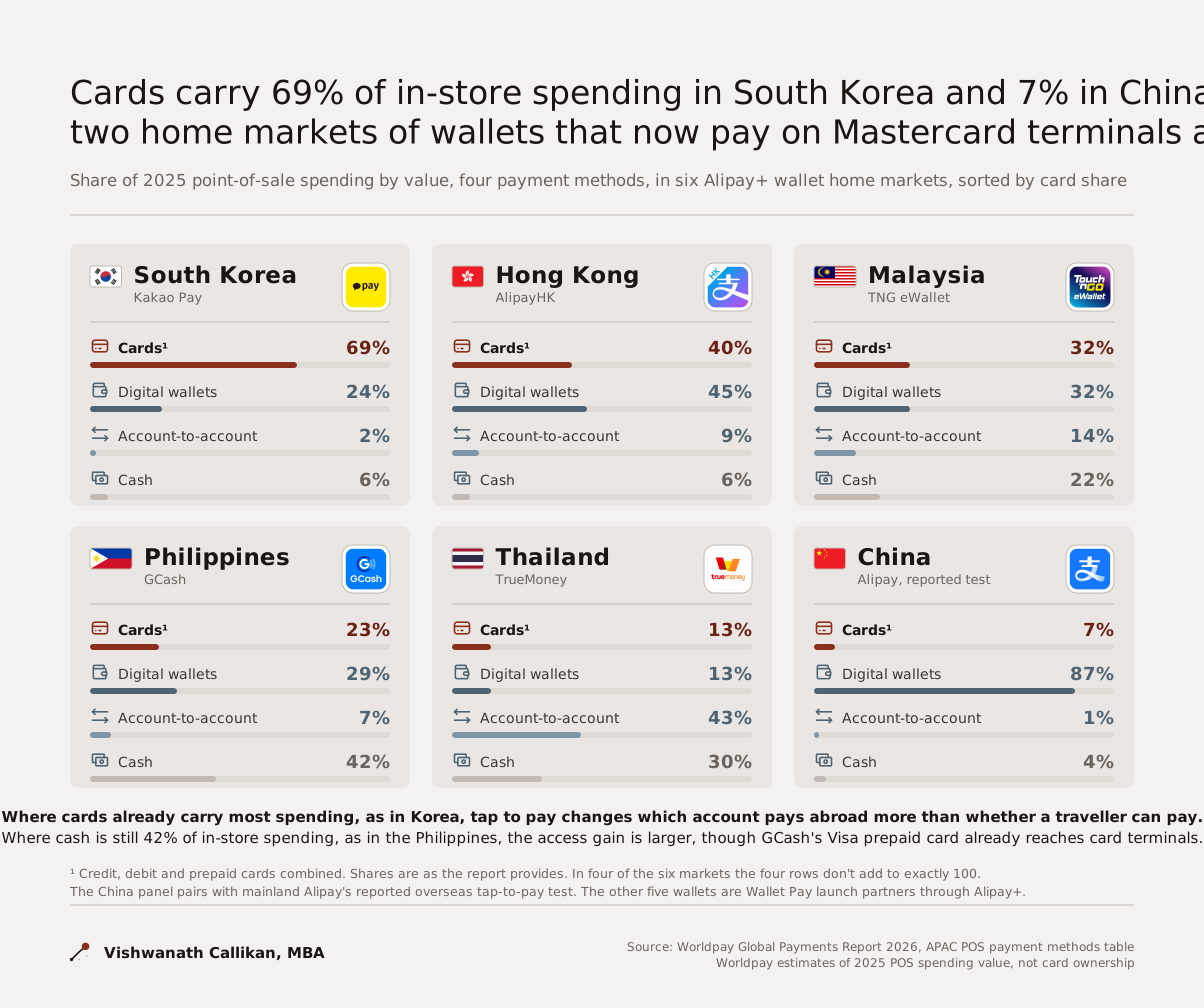
For most of these travellers, the question isn’t whether they can pay abroad but which account pays. Ji-woo almost certainly has cards, so what tap to pay changes is that her spending in London comes out of Kakao Pay rather than one of them, along with the currency margin and the record of the purchase. The access gain is larger for GCash users, whose home market still runs heavily on cash, although GCash’s Visa prepaid card means tap to pay may be a second way in for some of them rather than the first.
One caveat belongs here. The corridor people most often have in mind, mainland Chinese travellers in Europe, is the one where tap to pay is least established. Mainland Alipay’s version was reported as a test, on Android only, and I couldn’t find public confirmation that it has moved beyond that, so for now most of them still rely on the QR code at the counter.
Acceptance is being solved by translation, so the contest moves to which account pays
For most of the last decade, getting a wallet accepted abroad meant persuading merchants to take it, one QR sticker and one acquirer contract at a time. What Mastercard and Alipay+ have shown, and what Tencent is showing in the other direction, is that you don’t always need to. The payment can arrive at the merchant in whatever form the merchant already takes, and the wallet can carry on paying from the same balance or credit line it uses at home.
That changes where the competition sits. For a wallet, the question is no longer whether a foreign merchant accepts it but whether it stays the account that pays when its customer travels. For the networks, the question is which gateways they’ve signed to do the translating, and PayPal World’s route into Weixin Pay merchants shows the payment doesn’t have to travel as a card at all. Merchants, meanwhile, get the long tail of travellers at whatever they already pay for a foreign card, while the stores that court tourists keep paying for the wallet relationship.
Four things will show how far this goes. The first is whether Kakao Pay and the other Alipay+ wallets reach the iPhone without issuing a card, which depends on Apple as much as on them. The second is whether mainland Alipay’s tap to pay leaves testing. The third is whether Visa signs a large gateway onto Visa Pay. The fourth is whether Alipay+’s QR merchant count in Europe keeps growing or flattens now that tap to pay covers the long tail. If it flattens, I’d read that as tap to pay having taken over QR’s job for everyday purchases and left QR the marketing.
Ji-woo won’t notice any of this. She’ll pay for her next matcha the same way, from the same balance, and being the account behind that habit is what the wallets are now competing for.
Notes
Ji-woo and her matcha are hypothetical. The mechanism is from Alipay+’s NFC developer documentation, whose own example quotes a JPY/KRW pair, so GBP/KRW is my scene’s equivalent.
Merchant prices are published list rates read on the 27th of September 2026, before monthly fees, and negotiated rates differ. Adyen lists its Alipay+ fee in dollars, and the 11p fixed fee is the UK processing fee its pricing page applies to every method. The card cases use Mastercard’s EU commitment levels for interchange, or 1.98% at the top of Worldpay’s published consumer range, with scheme fees across Worldpay’s published range.
The GPR 2026 figures are Worldpay’s estimates of 2025 point-of-sale spending by value, from the report’s APAC table, with credit, debit and prepaid cards combined. They measure how people pay, not whether they hold a card.
Cross-border assessments are a gross revenue line, before the rebates and incentives Mastercard pays to customers. Net revenue is after them, so the two aren’t expressed as a share of each other.