



This week’s article is the result of an ashamedly bad habit of mine that I’ve never quite managed to shake. My mind refuses to leave something alone when it doesn’t make sense, and it will gnaw at me until I find clarity.
While writing my Visa A2A article last week, I read Stripe’s payout table as part of my research and landed on the row for Brazil. In it, Stripe states that it pays a Brazilian merchant 30 calendar days after a domestic card transaction is processed. That compares to 5 days after a sale on a foreign-issued card, and 2 business days after a Pix payment.
I did a double-take, and then another. My first assumption was a typo, so I went to Stripe’s Brazil-specific support page, and the 30 days was there too. Once I knew I wasn’t misreading it, the number made even less sense.
Before I go any further, a word on where I’m coming from. Alternative payments are my home turf, and I know the local rails of most markets well, but I’m not a card scheme specialist by any stretch of the imagination. What I do know is that plenty of things affect the date a merchant is paid for a card sale. Cross-border transactions settle on a different rhythm than domestic ones, commercial cards behave differently from consumer cards, and each scheme writes its own settlement rules.
So the questions that kept circling in my mind were pretty fundamental. Was this 30-day domestic card settlement a Stripe-specific merchant policy? Was it a Brazil market idiosyncrasy or a broader situation that applies across Latin America? Was there something to do with co-branded cards, or with Visa and Mastercard specifically, or with a domestic scheme whose rules I’d simply never read? Underneath all these questions sat the one I couldn’t get past.
How could a domestic card sale take a month to reach the merchant, in the same country where the same provider pays out a Pix sale in two business days, and most acquirers credit it the same day?
So I went digging around, trying to make sense of this. You’ll be happy to learn that the short version of my findings is that it isn’t a Stripe specificity at all. It’s actually written into the rulebooks of both card schemes in Brazil, and it appears to stem from a pricing decision taken by a card issuer back in 1984, in a year when prices in Brazil were doubling and then some. None of that is a delay per se.
In my research, I stumbled upon an article by Edson Santos at Neofeed, where I first saw the whole sequence written down. Edson describes a cardholder paying their issuer when the monthly bill falls due, at around day 25 or 26 after the purchase. The issuer then pays the acquirer at around day 28, and the acquirer pays the merchant at around day 30 or 31.
Edson’s article used that chain to ask what happens when one of its links fails, and who bears the loss when it does. I want to understand why the durations are what they are, who benefits from them, and what Brazil looks like next to its neighbours. If you’re unfamiliar with the Brazilian market, I’ve tried to explain each aspect, since I had to educate myself while piecing everything together.
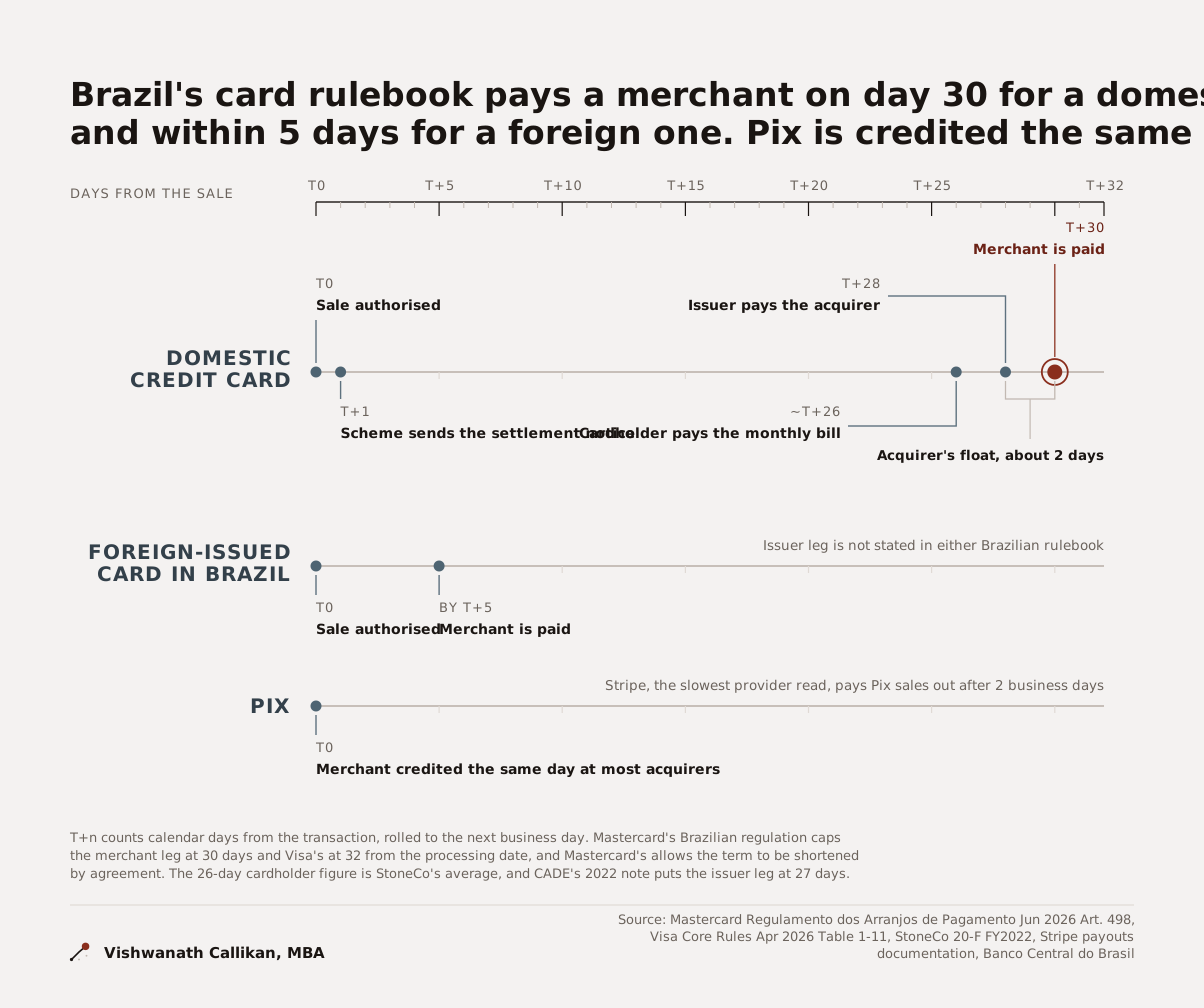
The thirty days is written into Mastercard’s and Visa’s Brazilian rules
Let’s start with who actually sets the date on which the acquirer pays the merchant, because I wrongly assumed it would be the regulator. Brazil’s central bank, the BCB, requires every card arrangement to define its own maximum deadlines for making funds available to the payee, in Circular 3.682 of 2013, but it sets no number of its own. The actual number lives in each scheme’s published Brazilian arrangement.
Mastercard’s Brazilian regulation, in its June 2026 edition, walks through the domestic settlement flow step by step in Article 498. Funds move between issuer and acquirer “em até D+1” for domestic debit and prepaid and “em até D+28” for domestic credit. The scheme then caps the acquirer’s own leg. An acquirer must make the funds available to its merchant within two days of the sale for debit and prepaid, and within 30 days for credit. The same article says the acquirer and its merchant can shorten this term by commercial agreement.
Visa’s public Core Rules tell every acquirer in the world to pay its merchants “promptly after Transaction Deposit”. However, Visa carves out and makes an exception for one country. Table 1-11, on page 121 of the April 2026 edition, gives Brazil a hard deadline of no later than 32 days after the processing date for a domestic credit sale and no later than 5 days for everything else, including any sale on an international card. No other country has its own table. Visa’s Brazilian regulation adds that the 32 days is the sum of two maximums: the issuer’s leg and the acquirer’s leg, with a same-day settlement lane and a deferred one underneath.
So the 30 days a merchant waits is, in Mastercard’s case, a number printed in the rulebook, and in Visa’s, a ceiling with a same-day lane already running underneath it. What I found somewhat frustrating is what neither document says.
Mastercard’s own rulebook moves the money between issuer and acquirer by day 28, and gives no reason anywhere for choosing that duration and settlement window.
The whole obligation is known on day one, and the acquirer then waits for the domestic issuer to fund it
After reading the rulebooks, I came up with two candidate explanations for the funding delay. The first was that somebody must be holding the merchant’s money for a month and earning interest on the float. The second was risk, since acquirers everywhere hold back funds against fraud and chargebacks. So let’s walk the sale through the rulebook and see where the money actually is.
On the day of the sale (T0), a shopper buys a pair of sneakers from a Brazilian merchant using a domestically issued Mastercard credit card, and the issuer authorises the transaction. On the next day (T+1), under Article 498, the scheme sends its settlement notice to the issuer and the acquirer, carrying the amount each owes or is owed and the value date on which the funds will move, and Núclea, the card clearing house, receives the same positions. By the end of T+1 the obligations are fully known, netted and dated.
The wait is now for the domestic issuer, and the date sits at T+28 because of the cardholder’s bill. StoneCo, the largest Brazilian acquirer not owned by a bank, states this most directly in its FY2022 annual report to the SEC, which summarises the chain in one sentence. A Brazilian consumer pays their credit card bill in 26 days on average, so the issuer pays the acquirer approximately 28 days after the transaction, and the acquirer pays the merchant approximately 30 days after it.
That “26 days” part of the sentence gave me pause, because it doesn’t describe a credit card instrument as I know it. A credit card runs on a revolving line of credit. The statement arrives, and the cardholder chooses between paying it in full and paying any amount from a minimum to below the full amount due, rolling the rest at interest. So on the day of the sale, the issuer has no idea when it will be repaid. A Brazilian card bills once a month, with a due date about ten days after the closing date, so the average purchase is roughly 26 days old when it falls due and is simply paid.
The number holds because most people pay in full, most of the time. The BCB’s 2022 banking economics report finds that about 71% of the balance owed is “à vista ou parcelado lojista”, paid in full at the bill or in merchant-funded instalments, neither of which carries interest, and only 17 to 20% is revolving. A 2016 thesis at FGV’s Business School in São Paulo, working from the industry’s own 2015 figures, put it more bluntly. In any given month, about 85% of cardholders paid the statement in full, 14% revolved, and those who did revolved for about 18 days on average, which suggests emergency use rather than a way of life. Brazilians, its author Suzanne Cordeau-Andrews concluded, use the credit card like a charge card.
A card that is paid in full 26 days after the purchase, as a matter of course, is behaving like a charge card, and that is how the Brazilian credit card is mostly used.
In July the BCB put the average rate on revolving balances at 436% a year. Since the CMN’s Resolução 4.549 of 2017 a balance can stay on revolving credit for one cycle only, after which the issuer has to move it onto a cheaper instalment line, and Lei 14.690 of 2023 capped the total interest and charges on a revolving balance at 100% of the original debt. So the credit doesn’t roll over from one month into the next the way it does on a card in London or New York, because the law doesn’t allow it. Add to that the fact that the consumer has a substitute that costs nothing, the parcelado sem juros, the interest-free instalment funded by the merchant, which Abecs puts at 42.6% of credit card value in 2025. When merchants split the price into ten interest-free payments at the till, you don’t need your issuer to lend you the money at 436%. The issuer therefore collects the whole month’s purchases around day 26 as reliably as a salary, pays the acquirer on day 28, and bears no cost of money on the grace period, because the merchant is the one who hasn’t been paid. That is a comfortable business model, and it has no reason to want the money to move any earlier.
Then comes the acquirer’s own leg, which is whatever it has agreed with the merchant inside the scheme’s cap. Until the issuer pays, the acquirer holds a dated claim on the issuer rather than cash, which is what StoneCo’s risk factors describe when they say the company must pay merchants independently of whether the issuing banks pay it. Cielo’s 2024 delisting valuation report models the business on 41 days of receivables from issuers against 34 days of payables to merchants. The acquirer’s float on a plain credit sale is around two days, which rules out my first candidate explanation.
The second candidate explanation, focused on risk, collapses once you look at which cards are paid fastest. Fraud and chargeback exposure typically rank a foreign-issued card higher than a domestic one. Conversely, the payout term ranks it lower, because Visa’s Brazilian table has the acquirer paying out a foreign card within five days, and a debit sale in a business day. What sorts these correctly is the day the cash actually lands on the ledger of the party that has to pay it on. For a Brazilian credit card that’s the day the cardholder’s bill payment reaches the issuer.
The clearest recent proof that the window is a credit exposure came this year, after Will Bank, a card issuer, went into liquidation in January and left between R$5bn and R$8bn (about $1bn to $1.6bn) of merchants’ sales made and not yet funded, with Mastercard and the acquirers arguing over who eats the loss. A 30-day window is 30 days of exposure to the issuer, and that argument stems from the window’s width rather than from one bad bank.
The 30-day window goes back to a 1984 price menu that inflation collapsed
While my candidate explanations failed to provide an answer, they did at least narrow down where to look. What is also irritating is that none of the research thus far explains why a Brazilian domestic credit card settles on a monthly calendar when a Mexican one doesn’t. For that, the most useful source I found reflects the industry’s own institutional memory.
In 2016, Brazil Journal published an account from Victor Esteves, who joined Credicard in 1978, of how the 30 days came about.
In the late 1970s, merchants paid on “oito, seis e quatro”. A merchant could be paid in 24 hours for an 8% discount rate, in 30 days for 6%, or in 60 days for 4%. The merchants had the benefit of choice. Inflation broke that pricing menu.
On the FGV’s general price index, the series the BCB publishes back to the 1940s, prices rose 77% in 1979. According to the IBGE’s IPCA, prices rose 215% in 1984, which is about 10% a month. At 10% a month, money that arrives 25 days late has lost roughly a twelfth of its value on the way, so an 8% discount for paying a merchant in 24 hours no longer covered what it cost the issuer to fund that payment. In 1984, Credicard ran campaigns to move merchants onto 30-day payment schedules at discounts of 2 to 4%, and, in Esteves’ words, within a few months more than 80% of merchants were being paid in 30 days.
A joint report by the BCB and two federal ministries says why it stuck after inflation was tamed. It describes the Brazilian term as around 30 days, compared with two abroad, and states that because cardholders pay about 28 days after purchase and merchants are paid at 30, issuers in Brazil don’t bear the cost of money over time. Bruno Salama’s May 2026 study for Instituto Propague says the same.
So what Brazil runs on the credit card rail is a funding calendar.
The settlement dates on a Brazilian credit card aren’t a clearing timetable set by the speed of the plumbing. They’re the dates on which each party in the chain is funded by the one before it.
The cardholder’s monthly bill sits at the head of that queue, and the merchant at the tail, with the plumbing underneath settling each obligation. The funding window is the product.
Brazil is the outlier among Latin America’s large card markets, and two central banks cap the days by rule
With the ’why’ now understood, the question becomes, is this a Latin American habit or just a Brazilian one? When you put the region’s published terms on one map, Brazil stands alone among the large markets.
Mexico bills its credit cards monthly too, and runs its own large interest-free instalment convention, meses sin intereses. Stripe’s own table pays a Mexican merchant in 3 business days, and Clip, a Mexican card acquirer, credits card-present sales immediately under its own terms. On an instalment sale, the merchant receives the full amount less a fee, as with a normal charge, so the issuer carries the instalment float in Mexico and the merchant pays a published fee for it.
Two of the other five LatAm countries examined have a regulator writing the funding window rules. Argentina’s central bank caps the payout for a one-payment credit sale at 8 business days for micro and small firms, 10 for medium ones and 18 for everyone else, and forbids the banks from charging merchants for those periods. Chile is the other, and it’s the most instructive of the five. Its central bank requires the operator’s contract with a merchant to pay either on the spot or within 15 calendar days of the sale. In practice, Transbank publishes 48 hours for credit, and then a merchant-funded instalment product paid in the same number of instalments as the sale. That’s Brazil’s parcelado lojista in a country with a 4.5% policy rate and a 15-day cap, and for me that makes the instalment stretch a credit product rather than a clearing constraint. Colombia pays the next business day and Peru in one to four days, both by commercial agreement rather than rule.
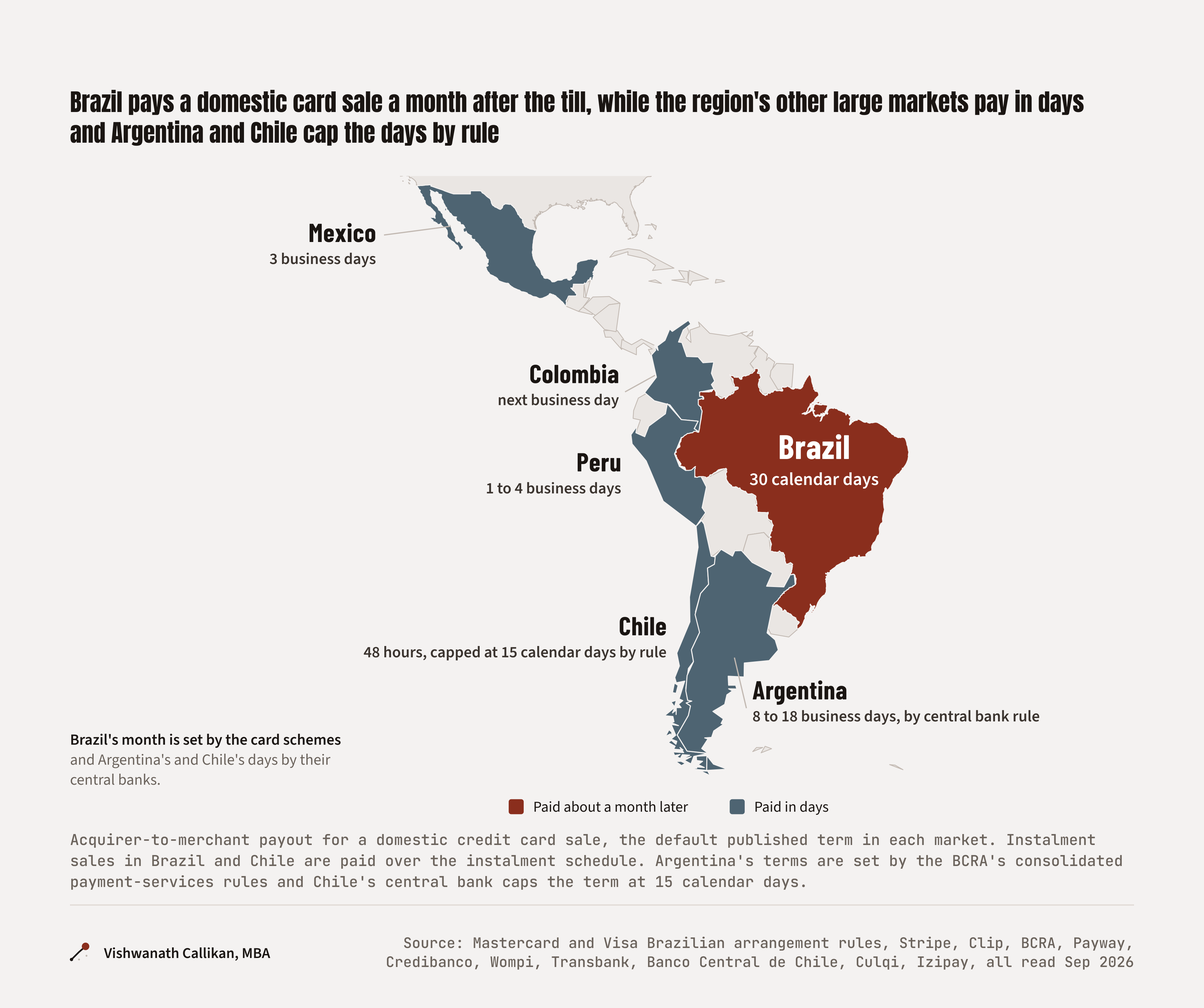
One note for any eager reader. Uruguay’s Handy sells a default credit term of 25 to 100 days, so Brazil isn’t the only long-term market on the continent, just the only large one.
Brazil’s acquiring market went from two competitors to more than 25, yet the payout term didn’t move
Worldpay’s Global Payments Report for 2026 puts credit cards at 31% of Brazil’s in-store spending and 40% of its online spending in 2025, something over $200bn a year. Abecs, the card industry body, puts foreigners’ card spending inside Brazil at a little over 2% of the R$4.5tn (about $880bn) its members processed, so the month is the term for about 98% of card credit sales in the country.
Until 2010, there were only really two acquirers, Visanet and Redecard, each exclusive to one scheme, until CADE’s settlement with Visa opened capture to rival brands in July 2010. The BCB’s 2023 banking economics report counts more than 25 by 2023, and its concentration index for acquiring halved between early 2018 and the third quarter of 2023.
Cielo, Rede, Getnet, Stone and PagBank lead the market. Behind them sit Mercado Pago, SafraPay, Fiserv’s Bin, Sicoob’s Sipag, SumUp, and CloudWalk’s InfinitePay. On the eCommerce side, the same rulebook binds Adyen, Stripe, EBANX, dLocal, PayPal, Nuvei, and PayU. FIG. 3 sets sixteen of them side by side, and where each one states the term, it turns out to be the main finding.
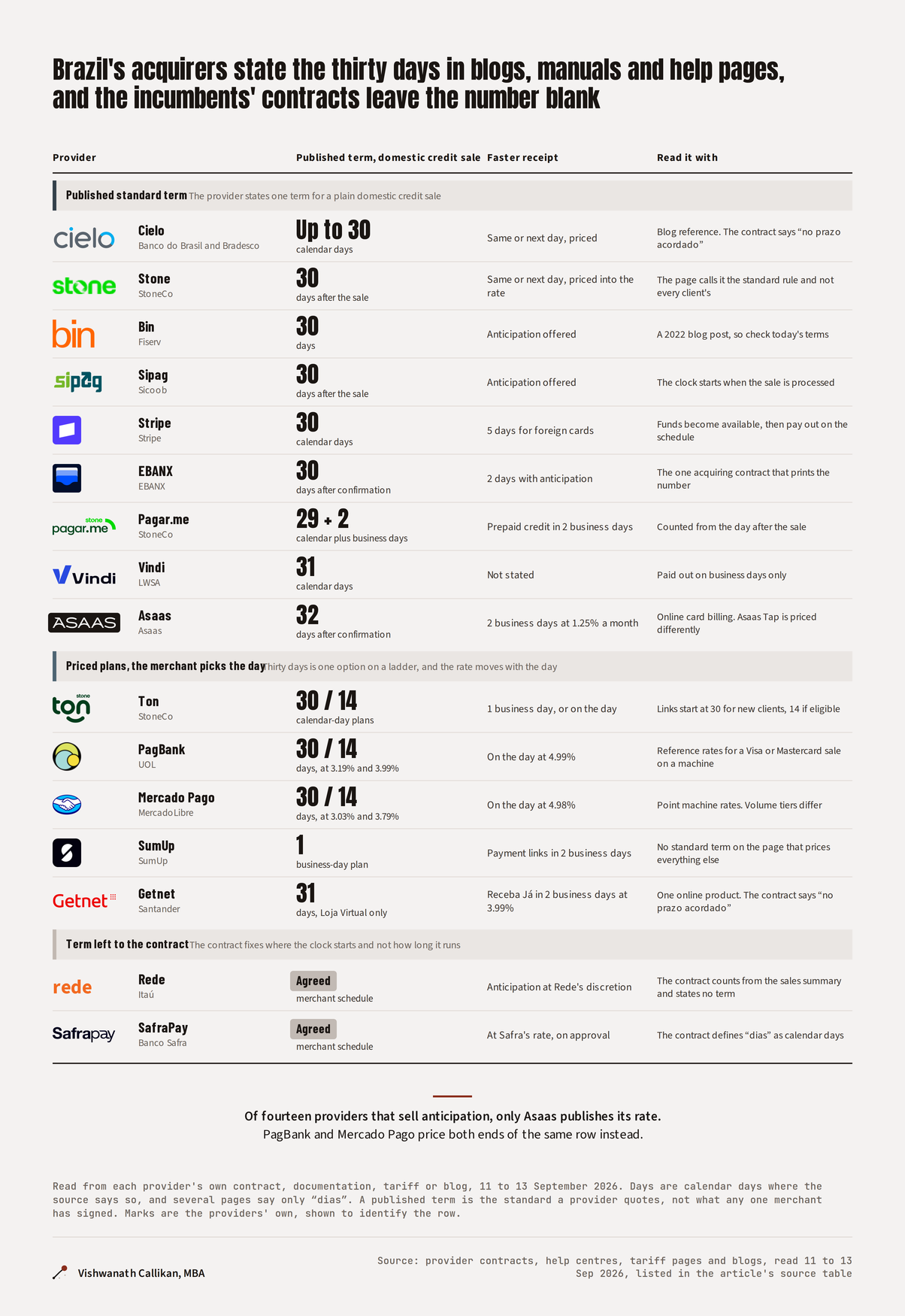
Across that roster, and across the halving of concentration the BCB measured, the term for a plain credit sale stayed where it was. Competition went into merchant fees and into selling merchants earlier access to their own funds. Competition didn’t, however, go into shortening the calendar without further compensation.
The thirty-day merchant funding window created an industry revenue line
Let’s face it, in the business of payments, if a merchant is at the tail of a funding calendar, somebody will sell them a way to the front. In Brazil, that product is antecipação de recebíveis, or as Google translates this for me, the anticipation of credit card receivables.
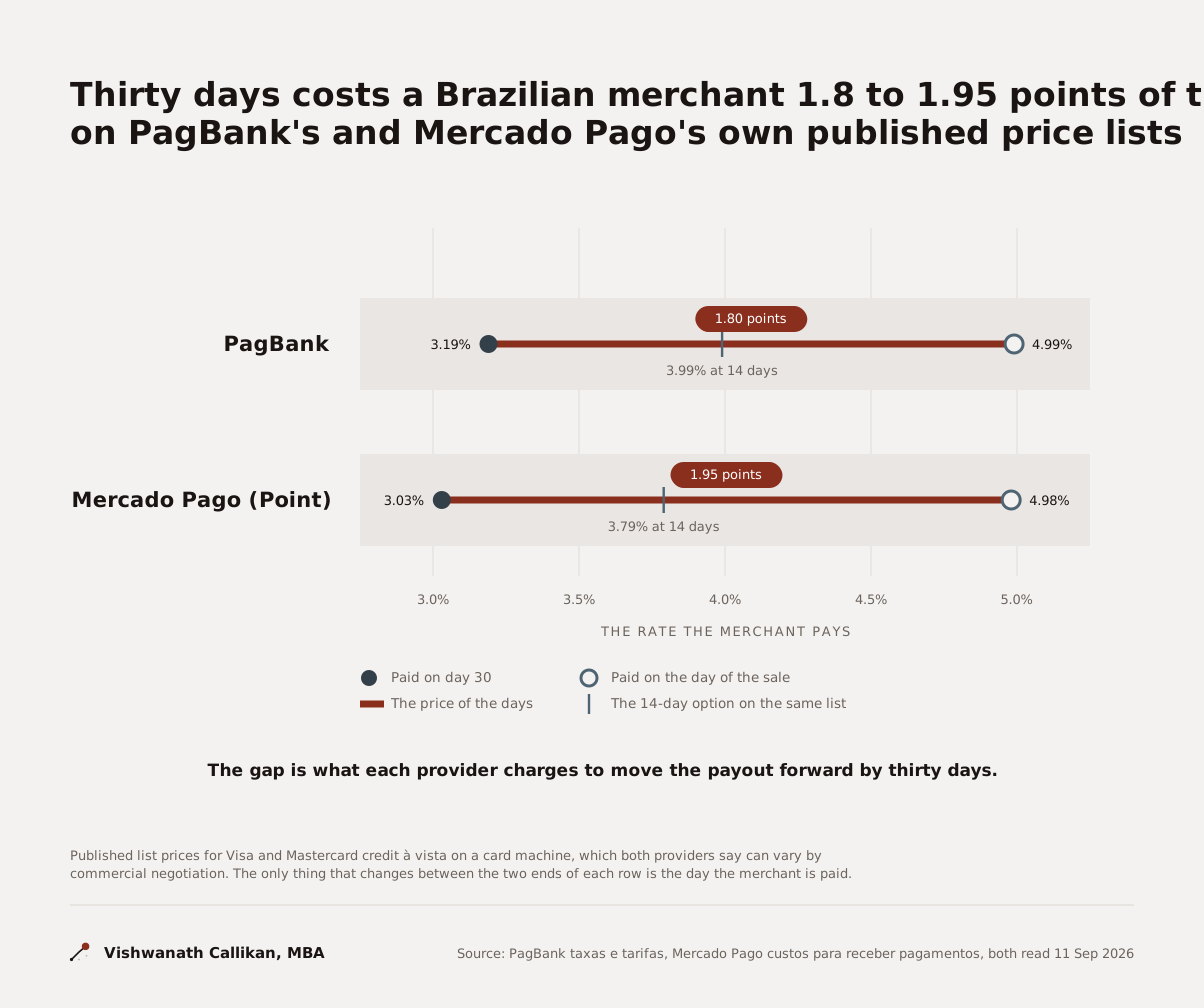
In my research, I found two providers that publish what a merchant pays to be funded sooner. PagBank’s price list for a Visa or Mastercard credit sale in one payment on a card machine is 4.99% if you’re paid on the day, 3.99% at 14 days and 3.19% at 30 days. Mercado Pago charges 4.98%, 3.79%, and 3.03%. Nothing else changes between those discount rates except when the merchant is paid, so being paid on the day rather than on day 30 costs 180 to 195 basis points of the sale, which on a R$10,000 sale ($1,950) is R$180 to R$195 ($35 to $38) for the month.
To understand the impact on an acquirer’s revenue, you have to look at its filings. StoneCo’s financial income, the line that carries prepayment, credit and float, was 50% of its total revenue and income in 2019. In the first quarter of this year it was 72.2%. PagBank’s went from 35.6% in 2019 to 56.7% in 2025. Neither company breaks anticipation out on its own, and both have widened what that line includes, so it’s a direction of travel rather than a like-for-like series, and the BCB’s own 2023 banking economics report drew the line more precisely, finding that for one type of payment institution 51.1% of payment-service revenue came from anticipation and 48.9% from merchant fees. And the demand keeps rising. Núclea, one of the receivables registries, told Valor in April that the volume anticipated grew from R$428.6bn ($84bn) in 2024 to R$614.9bn ($120bn) in 2025, up 43% in a year when credit card volume grew 14.5%.
Financial income, the line on which the two listed acquirers book what merchants pay to be funded sooner, alongside credit and float, is now more than half of what they earn.
Economists have measured what a payment term costs, but never on a card rail
I went in search of academic literature expecting to find the cost of a payment term well trodden, but it isn’t. The models that govern how regulators think about card fees have no variable for when the merchant gets paid, and the most recent one I could find, a Philadelphia Fed working paper from June 2025, assumes every processing cost other than interchange is zero. I also couldn’t find a single paper that measures what instant payments do to a merchant’s working capital.
The measurement exists, but next door, in the economics of trade credit. When the Chilean government pressed a big supermarket chain in 2006 to pay small suppliers within 30 days instead of around 90, Emily Breza and Andres Liberman found in the Journal of Finance that the chain took the money back as a 3.8% price cut, an implicit interest rate of 23% a year. That is Brazil’s arrangement in miniature. And an older Atlanta Fed paper on cheque float found that float can discourage the adoption of other types of payment, which, to me, suggests that whoever earns the float has a reason to keep the delay.
The issuer gets something real out of the calendar, and merchants are no longer sold the wait
As much as I’d like the argument to be one-sided, I’ve read enough acquirer filings to know it isn’t. Under this calendar, the issuer extends a monthly grace period and carries the interest-free instalments that 42.6% of credit card value now runs on, without bearing the cost of money for either. Move the issuer’s leg to day one and someone must fund the 27 days, which shows up either as a higher merchant fee, which CADE costed at 0.27 to 0.36% of the sale when Rede offered T+2 in 2019, or as a change to the instalment economics. Rede’s offer was free anticipation on an unchanged settlement date, and Brazil Journal reported a year later that it hadn’t paid off commercially.
And a Brazilian small merchant usually doesn’t get a 30-day term anymore. Cielo’s three published plans all quote payment within a day, and the challengers lead with “na hora”, paid on the spot. I’d put that as a fair rebuttal to any claim that merchants feel the wait. What they feel is the rate, and the rate includes the days.
Pix arrived next to that calendar, and what it changed is narrower than it looks. In the UK, an instant rail gains a merchant no days against a card that already pays in three business days. In Brazil, it arrived next to a card leg that pays on day 30, and person-to-business payments are now 43% of Pix transactions by count. The discount for paying by Pix at the till, which Lei 13.455 of 2017 allows, is a merchant using a 2017 law to step around a 1984 settlement convention. And Pix parcelado, sold in Cielo’s own marketing on the basis that the merchant receives the full value on the day while a bank carries the instalment loan, shows that what the instant rail changes is who funds the receivable.
Going back to the questions I started with
- Was it a Stripe-specific policy? No. Stripe’s table is the schemes’ Brazilian ceilings copied out.
- Was it a Brazilian idiosyncrasy? Yes, and a domestic-card one specifically. Visa’s public rules carve out one country by name, Mastercard’s Brazilian regulation prints the day, and both schemes put a foreign-issued card on a five-day clock.
- Was it a Latin American thing? No. None of the five neighbours runs a month as the standard term, and two of them cap the days by rule.
- Was it about co-branded or commercial cards, or a domestic scheme’s rule I’d missed? No on both counts. The rulebooks sort by the account behind the card and the direction of the transaction, not by whose name shares the plastic or whether the cardholder is a company, and the month sits in the two international schemes’ own Brazilian rulebooks. I couldn’t find Elo’s regulation published anywhere, and every acquirer page I read quotes one term for a domestic credit sale without distinguishing the brand.
The month isn’t a delay in moving the money. It’s the wait for the cardholder’s payment to land on the issuer’s ledger, so that each party in the chain can pay the next.
And the one I couldn’t get past: how can a domestic card sale take a month in the country where a Pix sale is credited the same day? It has the least satisfying answer. The two rails aren’t doing the same job. Pix moves money that already exists in the payer’s account. A Brazilian credit card sale creates a debt the cardholder pays in full at the end of the month, almost always, and the settlement calendar is that debt’s repayment schedule, passed down the chain to the merchant. That arrangement, priced in 1984 when a month of waiting cost a tenth of the sale, has outlived the inflation that made it because the cardholder who pays in full, the issuer that collects before it pays, and the acquirer that sells earlier access to the funds all have a reason to keep it.
That said, I think the 30-day calendar is a term somebody chose and can choose again, and the schemes’ own rulebooks say so. The BCB has never set a number and could, as Argentina’s central bank did in 2021 and Chile’s does at 15 days. The question for anyone whose economic levers sit on this rail, and I’d count acquirers, the schemes and the BCB among them, isn’t whether Brazilian card settlement could be faster, but who would fund the 27 days that the cardholder’s bill currently funds, and at what price, once the merchant is no longer the default answer.
Notes
Dollar figures are converted at R$5.12 to the US dollar, the market close on 11 September 2026, and rounded. They’re there for scale, and the reais are the numbers the sources print.
“Days” in this article are calendar days unless a source says business days. Several Brazilian provider pages, Stone’s and Getnet’s among them, say “dias” without saying which, and I’ve carried them as written rather than guessing. A published term on a provider’s help page is the standard it quotes, not what any particular merchant has signed, since the scheme term is a ceiling and the contract can sit anywhere under it.
On Pix, the rail credits the receiving account in seconds, and what a merchant sees depends on their provider. Cielo, Ton, Pagar.me, Asaas, PagBank and Mercado Pago all publish immediate credit for a Pix sale, and Stripe, the slowest term I found, pays out after two business days.
StoneCo’s and PagBank’s “financial income” lines carry revenue from credit products and float as well as from anticipation, and neither company reports anticipation on its own, so the shares quoted are the most the days could be earning them, not a measurement of it. The BCB’s 51.1% is the one figure that isolates anticipation, and it is for one category of payment institution in one year.
The inflation figures are annual rates. The IPCA is the IBGE’s consumer price index and begins in 1980, so the 1979 figure is the FGV’s IGP-DI. The “10% a month” for 1984 is the IPCA’s 215% compounded over twelve months.