



I’m not particularly averse to running a balance on my credit card. When a month runs heavier than planned, I typically pay part of the statement and roll the rest forward, then clear it the following month. I’ve never thought of that as unusual behaviour. Being from the UK at least, it isn’t uncommon. The Financial Conduct Authority (FCA) found that 31% of people who actively use a credit card revolve a balance, with close to half of everything owed on British credit cards accruing interest at any given moment. That is what a credit card is, or so I thought.
So when I was writing about Brazil’s 30-day card payout last week and read the line that Brazilian cardholders pay their bills in about 26 days on average, I took it simply as a timing factor and moved on. Sadly, my brain didn’t, and I started to ask myself If cardholders don’t borrow on their revolving credit lines, then what is a Brazilian credit card issuer, in actuality?
My question at least isn’t new. Milton Maluhy Filho, the chief executive of Itaú Unibanco, told analysts on the bank’s results call in August 2023 that 75% of the bank’s card book pays no interest, and that in developed markets the relationship is absolutamente inversa, completely reversed. Suzanne Cordeau-Andrews wrote in her 2016 thesis at FGV’s Business School in São Paulo, comparing Mexico and Brazil, that Brazilians use their credit cards like they would charge cards. I want to explore their thinking by tracing the pattern into the issuer’s income statement and asking what Brazil’s issuers are doing about the interest they don’t earn.
Most Brazilians pay their whole credit card bill, and quickly
At least three measures can be used to test the assertion that Brazilians pay their credit card bills in full and do so quickly. You can count the people who pay in full, count the money owed that earns interest, or look at the purchases themselves and how they were set up at the till, as a single payment or in instalments.
On the people side, Abecs and Datafolha ask a sample of cardholders every quarter whether they paid their last bill in full, and in March 2026 85% said yes. The association also says the answer has hovered between 85% and 90% for over a decade. Granted, it’s a self-reported figure from a trade body, but it agrees with everything else I found.
On the money side, the Banco Central do Brasil (BCB) publishes the household credit card book by modality every month. In July 2026, the book stood at R$745.7bn (about $146bn), and 75.7% of it carried no interest. That interest-free line is what the BCB calls à vista, purchases paid in full when the monthly card statement falls due or paid in interest-free instalments. The remaining 24.3% of the book splits two ways. 12.4% of the book was the rotativo, the revolving balance left when the card statement isn’t paid in full, and 11.8% was instalment plans with interest set by the issuer. So a quarter of the money owed on Brazilian credit cards earns the issuer interest, and that share has sat between 22 and 26% since 2023.
On the purchases side, Abecs reports the split by value rather than by number of transactions, so that’s the measure I have. Of the R$810bn ($158bn) spent on credit cards in the first quarter of 2026, 56.5% was spent as single payments, to be paid in full when the monthly card statement falls due, and 43.2% was spent as parcelado sem juros, the interest-free instalment the merchant funds. Instalments with interest chosen at the till, the kind an issuer would write, were about 1% of the value spent. So almost half of what Brazilians spend on a credit card is spent in instalments, and almost none of those instalments earn the issuer anything.
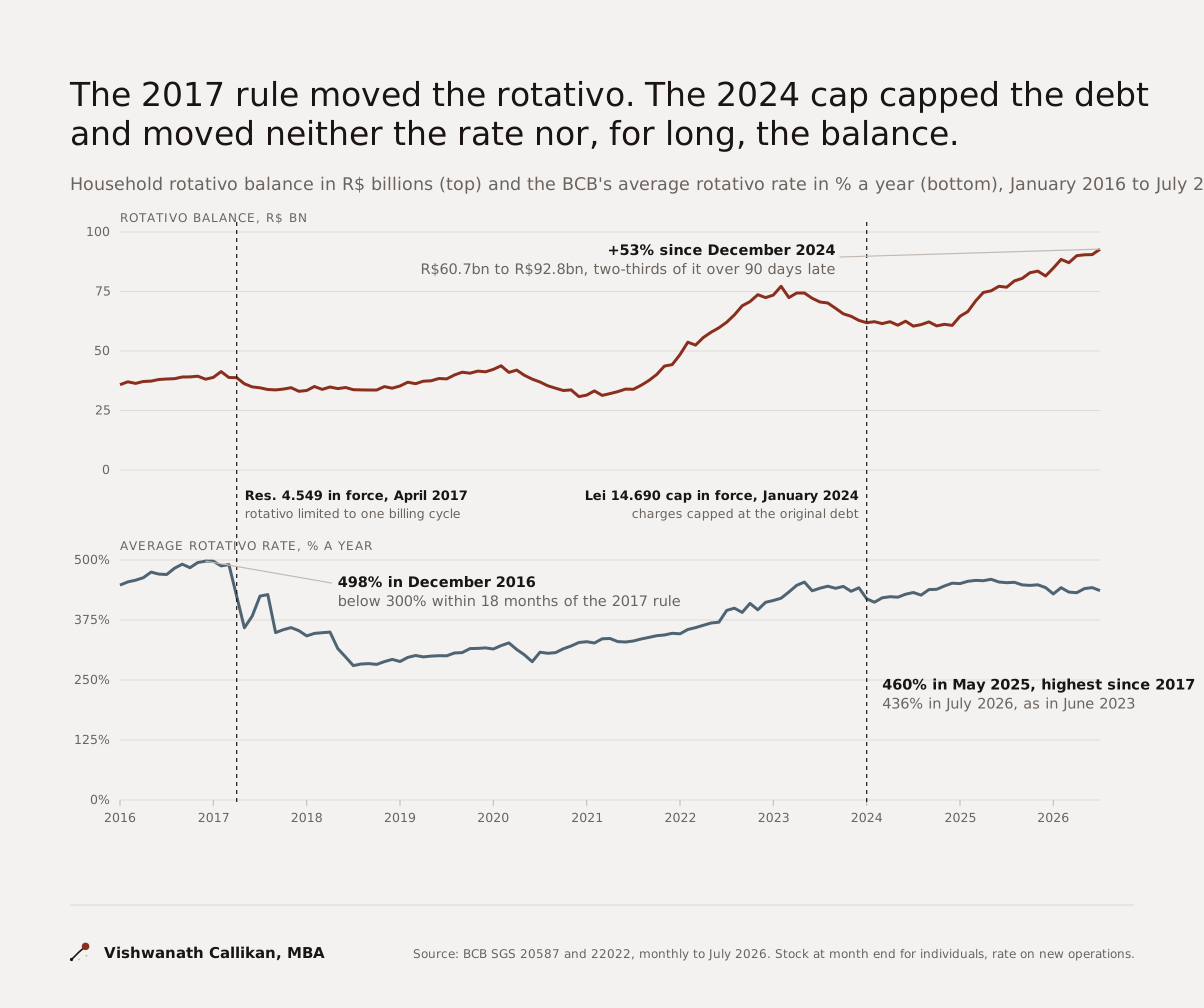
The interest-bearing quarter stays a quarter because a balance doesn’t linger in the rotativo. It’s priced and regulated not to. The BCB’s average rate on revolving balances was 436% a year in July 2026. Since the Conselho Monetário Nacional’s (CMN) Resolução 4.549 of 2017, an unpaid balance can sit in the rotativo only until the next monthly statement falls due, after which the issuer has to offer an instalment plan on cheaper terms, and since January 2024 Lei 14.690 has capped the total interest and charges on that debt at the original amount owed. Abecs data shows the average stay in the rotativo is between 13 and 16 days this year, and what’s left after that is mostly unpaid, since the BCB’s 90-day delinquency rate on revolving balances reached a record 64.5% in December 2025. Put simply, the rotativo doesn’t operate as a working credit line that people draw on and repay the way I do in the UK. It’s where unpaid bills gravitate to and collect.
The Brazilian rotativo isn’t a credit line people live on. It’s a two-week emergency credit line charged at 436% a year, and then the rules move you somewhere cheaper.
Brazil has the fewest revolvers of any big card market
A revolver is a cardholder who doesn’t pay their statement in full and carries the remainder into the next month, where it is charged interest. A transactor pays the statement in full and is charged no interest. Regulators measure this at a point in time, so a revolver in the figures quoted below is anyone carrying an interest-bearing balance in the month of the count, regardless of whether they habitually carry an interest-bearing balance or not.
That means there are two ways of understanding the market. You can count the people, the share of cardholders or accounts that revolve, or you can count the money, the share of all outstanding card balances being charged interest. The two are never the same number, because a transactor’s balance is one month’s spending about to be cleared, whereas a revolver’s balance is everything they owe, so revolvers hold a larger share of the money than they are of the people.
In the United States, the Consumer Financial Protection Bureau (CFPB) reports that about 50% of accounts revolved in 2024 and that, for large issuers, 82% of debt is revolving. In the UK, it’s 31% of active cardholders by the FCA’s survey and 47.6% of balances by UK Finance’s June 2026 figures. In Mexico, where Banxico calls a card that is cleared at month-end a totalero, 41% of cards were not totalero in December 2025, and they held 63% of the balance. In Brazil, it’s roughly 15% of people and 24% of the money.
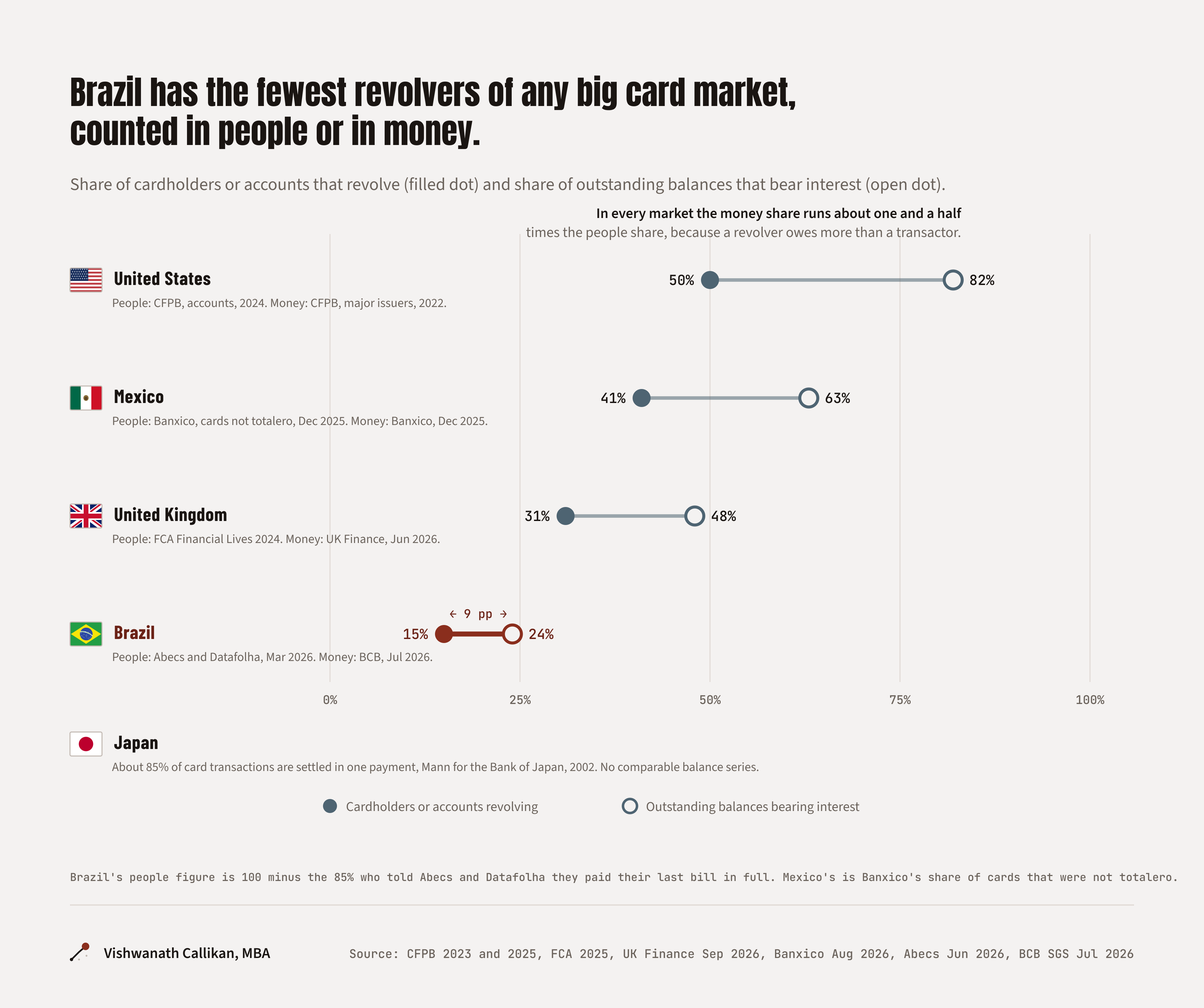
When read side by side, the pairs shown in the above chart have the same shape everywhere. Divide the money share by the people share and you get 1.6 in the United States, 1.5 in the UK, 1.5 in Mexico and 1.6 in Brazil. Put another way, in every one of these markets the average revolver’s balance is about one and a half times the average cardholder’s. What’s different about Brazil is that its pair sits at the bottom of both columns. The only market I found with fewer revolvers is Japan, where Ronald Mann’s 2002 study for the Bank of Japan found about 85% of transactions settled in a single payment.
Then there’s the price. The US rate on interest-bearing accounts was 22.15% in the second quarter of 2026, the Bank of England’s effective rate on interest-charging cards was 21.45% in July, Mexico’s revolvers paid 36.7%, and Brazil’s rotativo rate was 436%. A headline rate is not a cost, though. A British revolver pays 21.45% for as long as the balance lasts, which can be years. A Brazilian cardholder pays 436% for at most one billing cycle, after which the rule moves the debt onto an instalment plan at 189% a year (based on the BCB’s July figures), and the law caps total charges at the amount originally owed. Take the example of R$1,000 ($195) left unpaid and repaid over the following year. In the UK, that costs about R$110 ($21) in interest. In Brazil it costs about R$880 ($172), but it can never cost more than R$1,000 ($195) in total. The rate is twenty times the British one, a year’s borrowing costs roughly eight times, and the ceiling is capped at double the original debt value. Brazil is expensive, but bounded, which a British or American revolver isn’t.
The credit decision moved from the statement to the till
An observation I find most interesting comes from Mann’s study of Japan. An American cardholder decides whether to borrow when the statement arrives, by choosing how much of it to pay. A Japanese cardholder decides at the point of sale, where the terminal asks whether this purchase is one payment, several, or revolving. Mann traced the pattern to institutions, the limited powers of Japanese banks and the small size of Japanese retailers, rather than to national character, and I’d apply the same reasoning to Brazil.
I’d loosely frame the two above patterns and borrowing (credit) decisions as statement credit and till credit. Statement credit is the British and American model. The borrowing decision is made once a month when the cardholder’s statement lands. The amount borrowed is whatever isn’t paid off, and the issuer funds it and sets the price using the agreed interest rate. Till credit is the Brazilian model. The decision is made at the moment of purchase. The amount and the term are fixed then, and in Brazil’s case the shopper pays no interest, and most importantly the issuer doesn’t fund it either.
That last part took me the longest to see clearly, so let me walk it through. Let’s take the example of a shopper who buys a R$1,200 ($234) washing machine on a Mastercard-branded domestic credit card and chooses ten instalments sem juros at the till. Each of the cardholder’s ten monthly statements carries R$120 ($23). The issuer pays the acquirer for each instalment as it falls due, at T+28 for the first and every thirty days after, because that’s the term Mastercard’s Brazilian Article 498 sets between issuer and acquirer for domestic credit, and the acquirer pays the merchant on the same rhythm. So the party that sold a washing machine and has been paid nothing is the merchant, who either waits ten months or sells the receivable to the acquirer at a discount. The issuer collects R$120 ($23) around day 26 and pays it on at T+28, ten times over.
The BCB said this in its 2010 report on the card industry that Brazilian issuers “bear no financing costs in payment card transactions”. You can still see it reflected in balance sheets today. At the end of 2025, Nubank carried $18.3bn of credit card receivables and $13.6bn of payables to the card network, which is what it owes acquirers for its cardholders’ purchases. In other words, Nubank owes onward roughly three-quarters of what its cardholders owe it. The issuer isn’t lending that money, the merchant is. What the issuer does carry is the credit risk, because if the cardholder stops paying at instalment four, the issuer still owes the acquirer instalments five to ten and has earned no interest on any of them. That’s the asymmetry Maluhy called a subsídio cruzado, a cross-subsidy, where the interest paid by the few who revolve carries the risk on the interest-free instalments of the many who don’t.
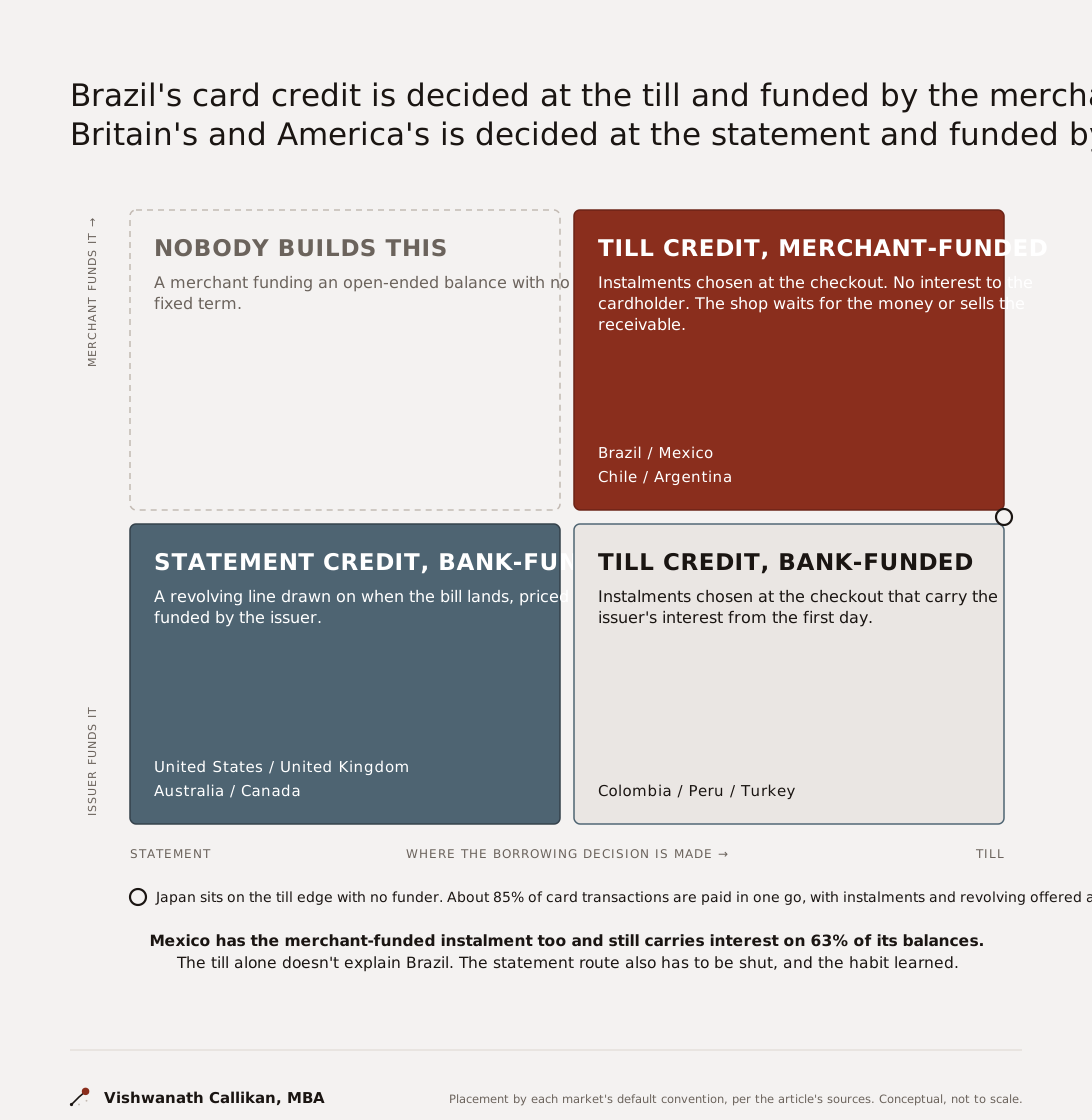
Mexico has meses sin intereses, its own merchant-funded interest-free instalment, yet 63% of Mexican balances bear interest. Guilherme Lago, Nubank’s chief financial officer, said on their 3rd quarter 2025 call that about 80% of the company’s Mexican card customers revolve against 10 to 15% in Brazil, on the same product from the same issuer. The difference is that in Mexico the statement route is open and merely expensive, whereas in Brazil it’s shut by price and by rule. So the interest-free instalment on its own doesn’t produce a country of transactors. Brazil has the instalment at scale, a closed-statement route, and, on top of both, a shopper who reaches for the instalment rather than the statement. That cultural habit is the part the economics finds difficult to explain.
In Britain and America the card is a loan that happens to pay for things. In Brazil it’s a payment schedule that happens to be issued by a bank, and the credit lives with the merchant.
So what makes Brazilians pay the bill in full?
Two explanations are usually offered to explain this behaviour. The first is that Brazilians are simply more disciplined about card debt. When the World Bank’s Findex survey asked cardholders in 2021 whether they had paid their balance in full, the share saying yes was about the same in Brazil, the United States and the United Kingdom (figures in the notes). The difference shows up in the account data, not in the self-portrait, which, for me, says the design is doing the work rather than the person. The second explanation is financial literacy, and that one fails harder. The BCB ran an experiment on the design of the card statement and found that only 1% of the control group could correctly identify what the rotativo would cost them. Brazilians pay the bill without understanding the price of not paying it.
So if it’s neither, then what is it? I believe it is a combination of the following three things that help explain the behavioural pattern.
First, the instalment habit predates the card by decades. Retail credit in Brazil ran on the carnê, the booklet of monthly slips a shop issued, long before banks were involved. A study of Lojas Pernambucanas in the Revista da ANPEGE traces its Crediário Tentação to the 1970s, and Casas Bahia still had R$6.17bn ($1.2bn) of carnê credit outstanding in June 2026. When Credicard moved Brazil’s merchants to thirty-day settlement in 1984, it fit the card to how retail merchants already sold everything in prestações.
Second, inflation memory and pain. Between 1980 and 1994, a fixed schedule of nominal instalments was a gift to the borrower, because the last instalment was worth a fraction of the first, and a generation learned to buy that way. José Fajardo and Manuela Dantas found in a 2018 paper that Brazilians who lived through the hyperinflation as young adults save less and hold fewer equities decades later. The paper doesn’t test instalments, but it would be odd for a country that spent fifteen years learning to prefer a fixed nominal payment to have unlearned it.
Third, the psychology of the instalment itself, where the behavioural literature written about Americans reads as if it were about Brazil. Drazen Prelec and George Loewenstein’s work on the pain of paying found that paying hurts most when it’s uncoupled from the thing bought, which is exactly what a revolving balance is, a debt with no purchase attached to it any more. A fixed instalment stays attached to its washing machine. John Gourville’s pennies-a-day research showed that reframing a price as a small recurring amount changes whether people buy at all, and 12x de R$99 (twelve payments of R$99, or $19) is that reframing at national scale. The Brazilian phrase for it is that the instalment cabe no bolso, it fits in the pocket. Statement credit asks the opposite. Neil Stewart showed in Psychological Science that merely printing a minimum payment on the statement lowers what people repay, because the minimum becomes the anchor. If you designed a card to be paid in full, you’d design the Brazilian one.
The card didn’t teach Brazilians to buy in instalments. It inherited a habit the carnê built and hyperinflation taught.
A Brazilian issuer still earns like a lender
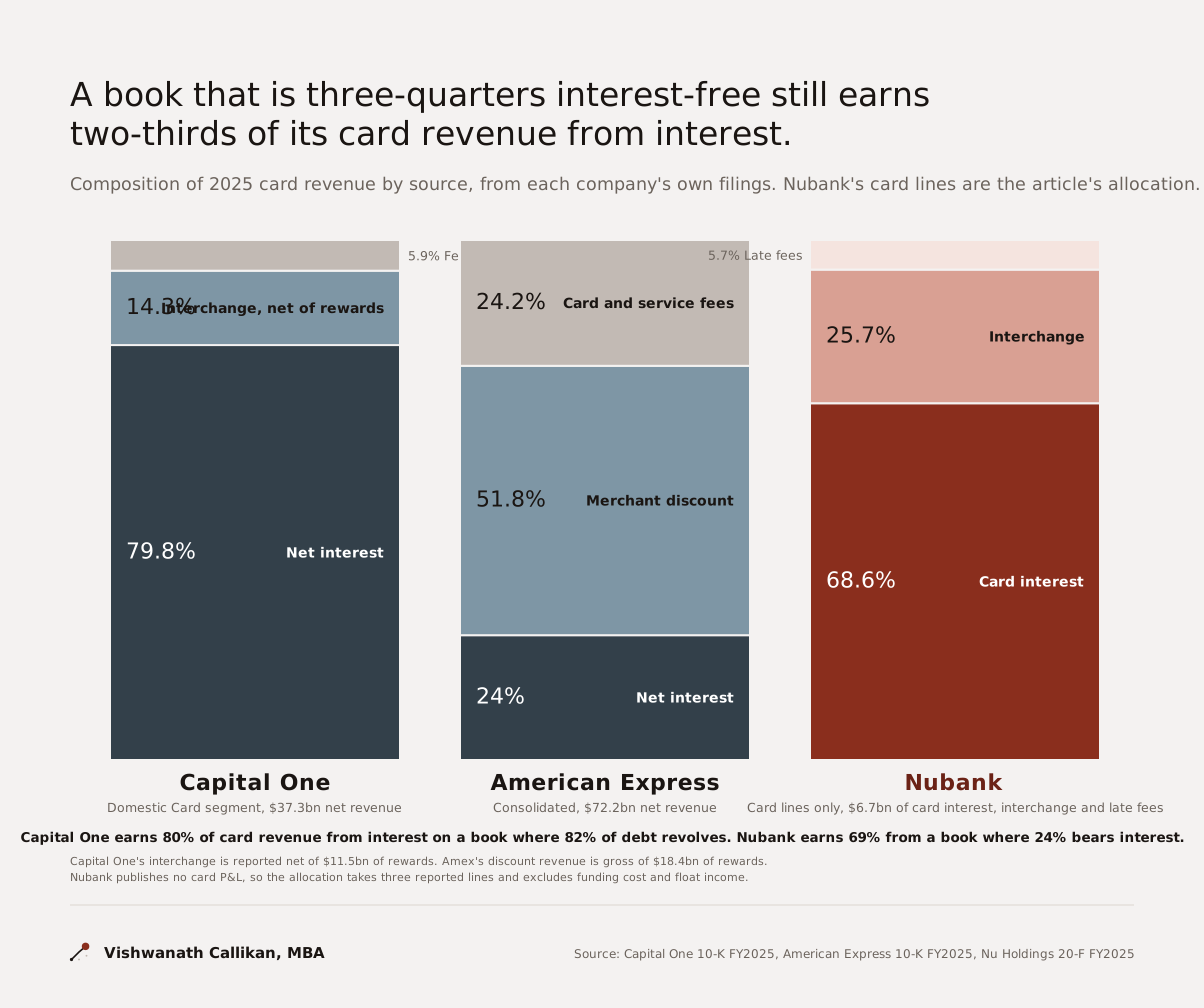
Now, what does all of this do to the people who issue the cards? The Federal Reserve reports to Congress every year on the profitability of the banks that do almost nothing but issue cards, and its November 2025 report found that these banks earned a 3.87% return on assets (RoA) in 2024 against 1.38% for the banking system as a whole. The same report also shows where revenue comes from, as a share of the bank’s assets. Interest income came to 13.94% of assets, and non-interest income, which is interchange and fees together, to 6.34%. Together, gross revenue is about 20% of assets, with interest roughly 69% before any costs are paid. Capital One’s domestic card business is the same picture in one company, with $29.8bn of net interest income on $37.3bn of net revenue in 2025, which is 80%.
The exception that proves the point is American Express. In 2025, Amex earned 51.8% of its net revenue from merchant discount, 13.8% from card fees and 24% from net interest. It can do that because it charges merchants well over 2% and charges cardholders hundreds of dollars a year to hold the card. A transactor is a fine customer when the transaction is priced like that.
So here is the puzzle I expected to find in Brazil. If three-quarters of the balances pay no interest, the Brazilian issuer should look like Amex without the price, and its income statement should be missing the line that carries Capital One. It isn’t. Nubank’s 2025 accounts are the cleanest test, because Nubank is one of the largest issuers in the country and reports in one currency. In 2025 it earned $4.60bn of interest on credit cards, $1.72bn of interchange and $0.39bn of late fees. If you allocate only those three lines to the card (using my arithmetic rather than Nubank’s), interest is 69% of card revenue. That is the Fed’s number for a US card bank, almost to the point, from a book where a quarter of the balances bear interest.
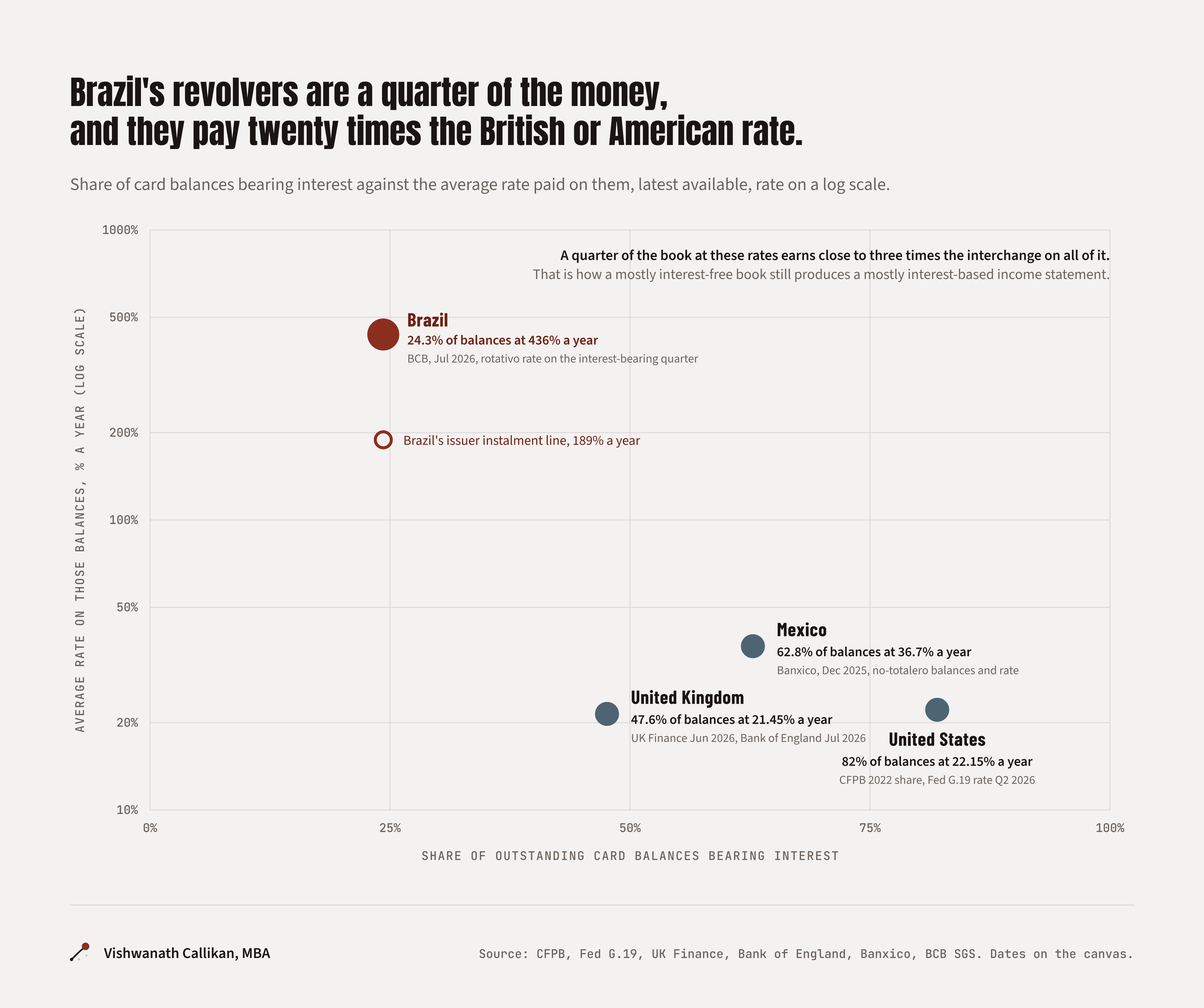
The price is what makes that work. A quarter of the book at 189% and 436% earns roughly what four-fifths of a US book earns at 22%. What the Brazilian issuer is missing is the other half of the Amex model, the price on the spend. Credit interchange in Brazil isn’t capped the way debit interchange is, but it’s nowhere near a 2% merchant discount, and the anuidade, the annual fee Brazilian banks used to charge for the card itself, has been eroded since Nubank launched a card without one in 2014. Itaú’s card fees were R$16.8bn ($3.3bn) in 2025, down 1.4% on the year while purchase volumes grew at double digits.
What Brazil’s issuers are doing about the interest they don’t earn
The BCB wrote in 2010 that the issuing business “would not break even” without rotativo interest, and fifteen years on, every Brazilian issuer is asking how to earn financing income from customers who have learned they don’t need it. The answer, as far as I can extrapolate from the filings and the calls, is not to make more Brazilians revolve. Instead, it’s to build an interest-bearing instalment inside the transactor book, where the transactor already goes.
Nubank is the most transparent case because it disclosed the number for two years. On the 4Q22 call, interest-earning instalments were 12% of its credit card book. By the third quarter of 2024, the company’s release put it at 28%, driven by its Pix and boleto financing products; by the 1Q25 call, the figure was 29%, the last time it was stated. Over the same period, it held revolving balances at 6 to 7% of the book, versus a market average of 16 to 17%, and said so as a choice. The growth came from Pix no crédito, launched in July 2022, which lets a cardholder send a Pix against the card limit and repay it in one go or in up to twelve instalments with interest. The recipient is paid instantly, and the payer takes a priced instalment loan at the time of the transaction. By December 2023, more than 35% of Nubank’s active card customers were using it.
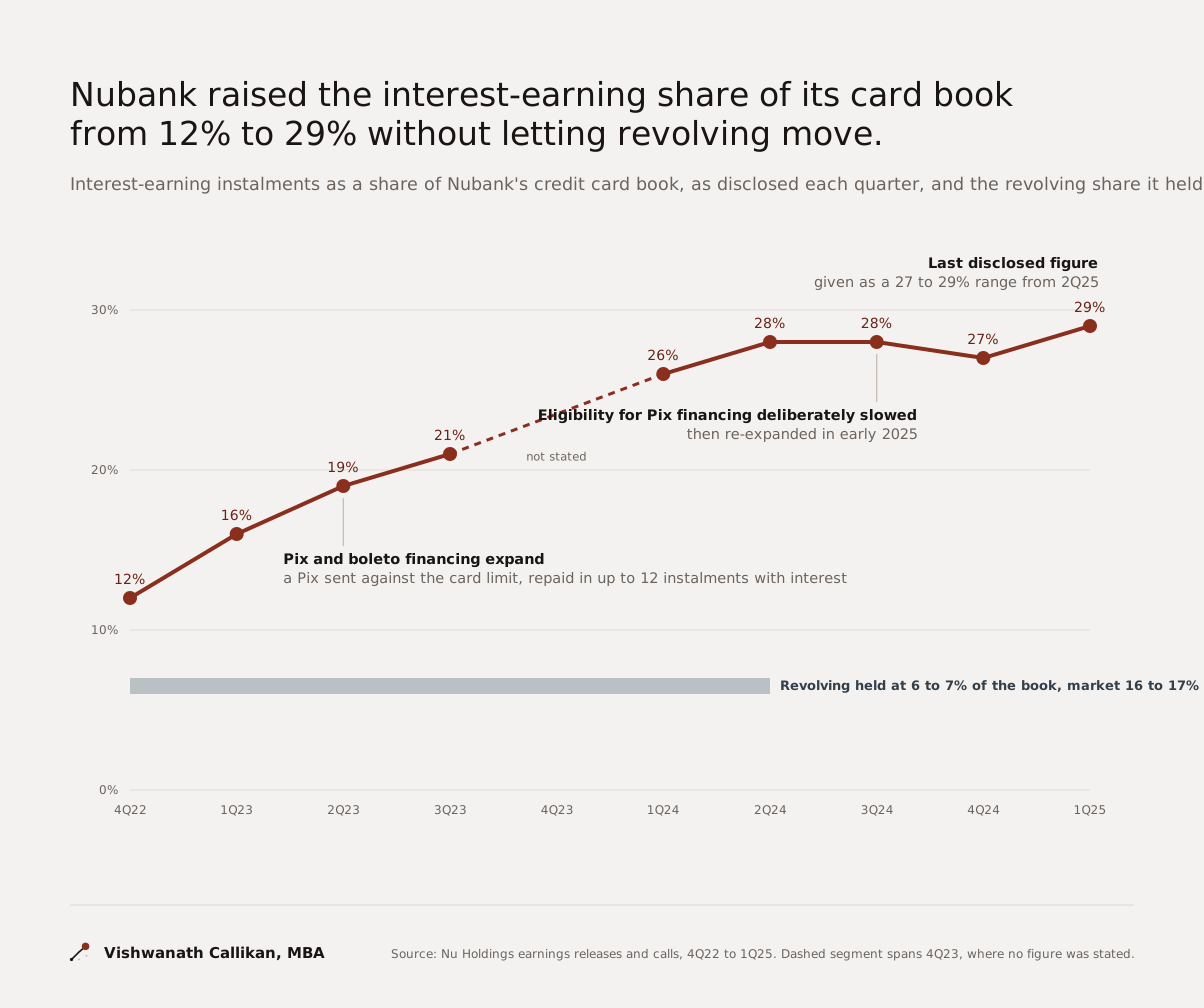
The incumbents are doing something similar. Rogério Panca of Santander said in March 2024 that the industry had to keep shrinking the base of interest-free balances, and Abecs said at the time that it was designing a standardised crediário, an issuer-funded instalment with interest, to sit beside the merchant’s interest-free one at the same checkout. The policy fight went the same way. In October 2023 the BCB proposed limiting interest-free instalments to twelve, the acquirers, the retailers and Abecs opposed any cap, and what came out of the CMN in December 2023 was Resolução 5.112, which capped rotativo charges and left parcelado sem juros exactly where it was. Febraban called the cap “temporário”. The fight in Brazil has never really been over the revolving credit line but over who gets to write the instalment, at what price and earn the interest.
The one thing the cap didn’t do is the thing most people assume it did. It didn’t shrink the rotativo. The posted rate was 436% in June 2023, reached 460% in May 2025, its highest since 2017, and was 436% again in July 2026, because the law capped the amount a debt can grow to rather than the rate. And the rotativo balance, which fell through 2024, has risen 53% since December 2024, from R$60.7bn ($12bn) to R$92.8bn ($18bn), with a record share of it more than ninety days late. I don’t have a clear explanation for that rise, and I’d rather say so than invent one.
Then, in December 2025, the BCB stepped back from writing a rulebook for Pix Parcelado, the instalment product it had planned to standardise on the public rail, as I covered in the credit-on-public-rails article. From the issuer’s side, it leaves the field to the product Nubank has been growing since 2022, an instalment on the public rail written by the card issuer at the issuer’s price. That is a charge card being turned back into a credit card, one Pix at a time.
Nobody in Brazil is trying to make cardholders revolve. The issuers are building a priced instalment inside the transactor book, and putting it where the transactor already goes, which is the till.
Where the charge-card reading stops being fair
As much as I like the hypothesis and direction I’ve just laid out, I’d rather call out three main objections than sweep them under the carpet.
First, the minority in the rotativo is in real trouble, and “a two-week emergency” undersells it. Around two-thirds of that R$92.8bn is more than ninety days late, and the BCB’s 2023 update on risky debt counted 15.1 million Brazilians, 14% of everyone with credit, as exposed at once to the rotativo, unsecured personal loans and the overdraft. The rotativo is small as a share of money. It isn’t small as a share of misery.
The second is that sem juros is a claim about the cardholder, not the economy. The BCB’s own working paper on card pricing shows that the cost of card acceptance ends up in everyone’s sticker price, and the merchant who waits ten months or sells the receivable pays a real rate for the instalment. So my claim is the narrower one, that the instalment carries no interest for the cardholder and is funded by the merchant. Who ultimately bears the cost of “free” is a question nobody has answered empirically.
The third is that a charge card is paid off every month, and a Brazilian cardholder with four open instalments isn’t. CNDL and SPC Brasil found 60 million consumers in the state capitals with instalment purchases outstanding at the end of 2025, four open on average. That’s a fair correction to the label. The Brazilian card is a charge card in its relationship with the issuer and an instalment plan in its relationship with the household budget.
That said, I think my hypothesis and articulation holds true where it matters for anyone who issues, acquires, or prices cards. The Brazilian credit card is a payment instrument with a small, expensive and regulated credit line attached, and the issuer’s income statement has been rebuilt around a quarter of the book because the other three-quarters never borrow.
Coming back to the question I started with
I asked what a Brazilian credit card issuer is if cardholders don’t borrow, and I’ve concluded it’s a risk-carrier priced like a lender. It underwrites every instalment a merchant sells, funds none of them, and makes its money from the minority the design leaves behind. In Britain and the United States, statement credit converts a payment instrument into a loan at the moment of least attention. In Brazil, the same conversion has to happen at the till, in the open, with a price on it, against a merchant offering the same instalment for nothing. That is a harder sell, and it’s the sell every Brazilian issuer is now making.
The wider point, for me, is that the credit card is two products sharing a piece of plastic. One is a loan the bank prices and the cardholder decides on a monthly basis. The other is a payment schedule the shop offers, and the cardholder decides on at the checkout. Brazil built the second on a habit the carnê left behind, and its issuers are now trying to sell it the first. Whether shoppers who have spent forty years learning that the instalment costs nothing will pay for the version that does is the question I’d watch.
And I’ll still be running the odd balance in the UK, at 21.45%, without an instalment in sight.
Notes
Dollar figures are converted at R$5.12 to the US dollar, the market close on 11 September 2026, and rounded.
“Pay in full” figures are self-reported where they come from a survey (Abecs and Datafolha, the FCA’s Financial Lives) and account-based where they come from a regulator (the CFPB, Banxico). Surveys flatter repayment. The Brazilian press reports that 82% of families are in debt, but CNC’s survey counts a card bill that will be paid in full on the due date as a debt. On the BCB’s measure the rotativo is about 2% of what households owe.
The World Bank Findex figures are the unweighted shares of cardholders in the 2021 microdata who said they paid their balance in full, 77% in Brazil, 76% in the United States and 80% in the United Kingdom.
The interest-bearing share of Brazil’s card book adds the BCB’s rotativo and parcelado series and divides by the total for individuals. The BCB’s à vista line includes instalments not yet billed, so it isn’t directly comparable with a statement-date measure like UK Finance’s. The US 82% is the CFPB’s 2023 figure for major issuers.
The R$1,000 worked example converts each annual rate to a monthly one and assumes equal monthly repayments over twelve months, at 21.45% in the UK, and in Brazil one month at 436.2% then eleven at 189.3%, the BCB’s July 2026 averages, ignoring fees. Lei 14.690 caps the Brazilian total at the original debt.
The Nubank card revenue split allocates only three reported lines to the card and ignores funding cost and float income. Nubank doesn’t publish a card profit and loss. The 29% interest-earning instalment figure is the last one it disclosed, in May 2025.
The rotativo series are the BCB’s SGS 22022 and 20587, pulled on the 20th of September 2026.