

On its own website, iDEAL describes itself as a guaranteed online transfer. In other words, it is an irrevocable push from a shopper’s IBAN to a merchant’s (although in practice, often an acquirer’s) and confirmed in real time. Once the shopper approves the payment, the money is coming towards a happy merchant, and they can rest assured that it is not coming back through the scheme. Buckaroo, one of the acquirers now onboarding merchants to Wero, states this last part quite clearly, writing, “Unlike iDEAL, Wero is not a guaranteed payment method.”
Between those two sentences sits most of what European merchants and their payment providers are currently negotiating with the European Payments Initiative (EPI).
Wero has spent the past year hitting genuine adoption milestones, and roughly the same period discovering that the acceptance side it inherited is not the acceptance side it still needs to win. Merchants were told early on, reasonably enough, that Wero would replace the iDEAL and Payconiq payment methods they accept across key markets. What they are being handed is an account-to-account (A2A) scheme with a card-style disputes layer sitting on top of it. That layer carries card-style obligations for the people accepting Wero, which is not what a replacement means in any operational sense.
Wero was never a like-for-like replacement, but rather a different bargain wearing a replacement’s branding.
The disputes model merchants and PSPs are resisting is, in my view, the deliberate price of competing with cards, and the concession the EPI made to Dutch merchants and acquirers in mid-July, real as it is, only served to move the “when” rather than the “who” that ultimately carries the risk.
Wero’s milestones are real, and so is the gap behind them
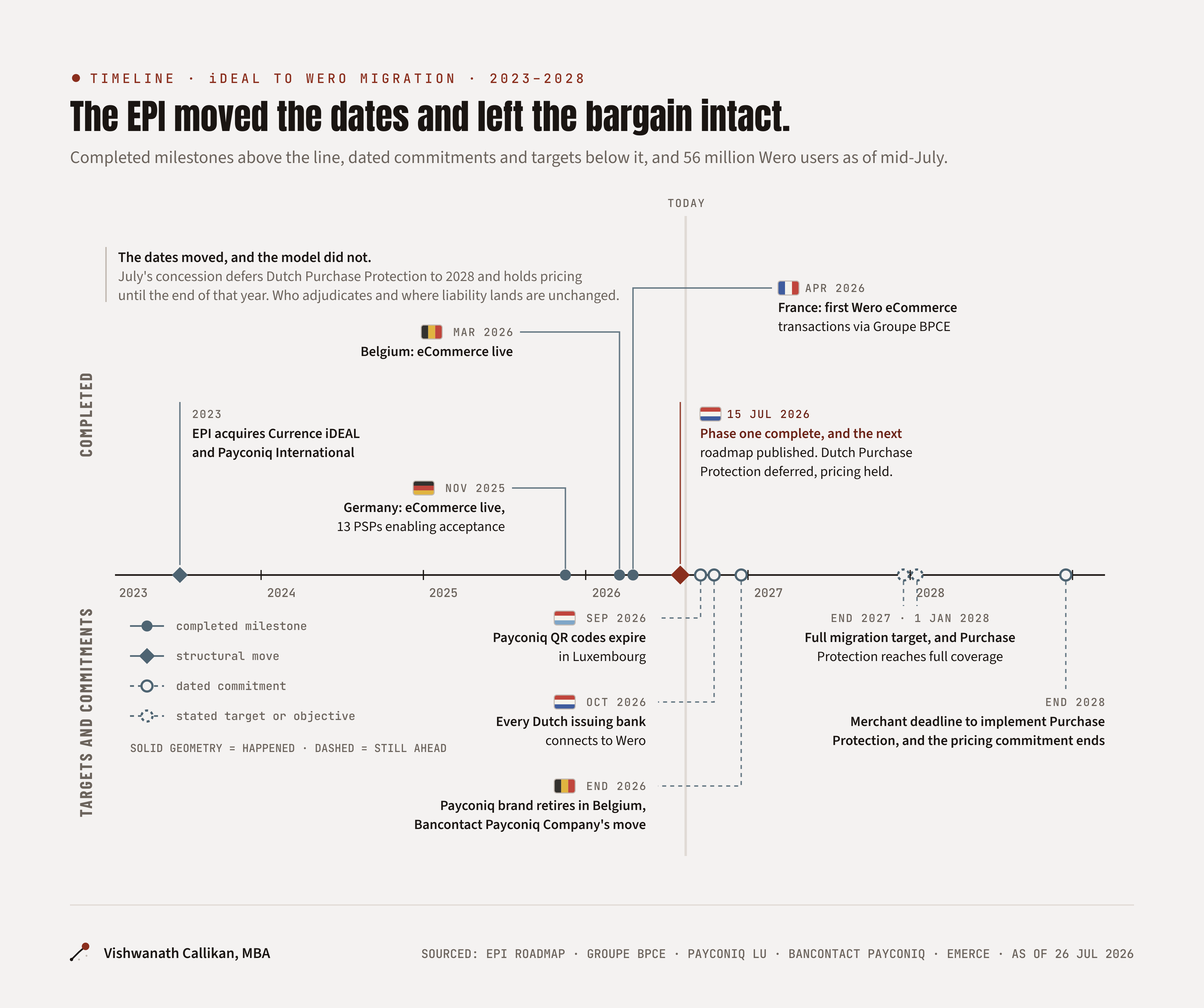
Let’s start with what the EPI has actually built. Wero counts 56 million users across Belgium, France and Germany as of mid-July. eCommerce went live in Germany in November 2025, with Eventim, Lidl, Rossmann and Decathlon among the launch merchants and thirteen named PSPs and acquirers enabling acceptance. Belgium followed in March 2026, with Ahold Delhaize and Bpost on the roster. France completed its first eCommerce transactions in April through Groupe BPCE, with a scale-up to thirteen million customers announced for this summer.
The consolidation of the schemes the EPI bought in 2023 is proceeding on plan too. The first phase of the iDEAL migration is complete, with Dutch transactions already processing on Wero’s platform. This is no small scheme to absorb, since the EPI itself puts iDEAL at around 72% of Dutch eCommerce across more than 350,000 businesses.
In Luxembourg, Payconiq’s QR codes expire in September as merchants migrate onward. In Belgium the Payconiq brand disappears by the end of 2026, and that sunset is Bancontact Payconiq Company’s move rather than the EPI’s. The direction is the same either way, because the old A2A brands are being retired in Wero’s favour.
The gap is on the acceptance side. Handelsblatt found the German rollout “schleppend”, sluggish, with the top merchants missing. A Händlerbund survey around the same time had three-quarters of surveyed retailers in wait-and-see mode, with none of the top ten eCommerce retailers yet integrated. Consumer reach has been assembled through bank distribution and payment brand acquisition. But acceptance is still being negotiated gradually, one merchant at a time, and that negotiation has a specific sticking point.
Under Wero, merchants give up certainty rather than familiarity
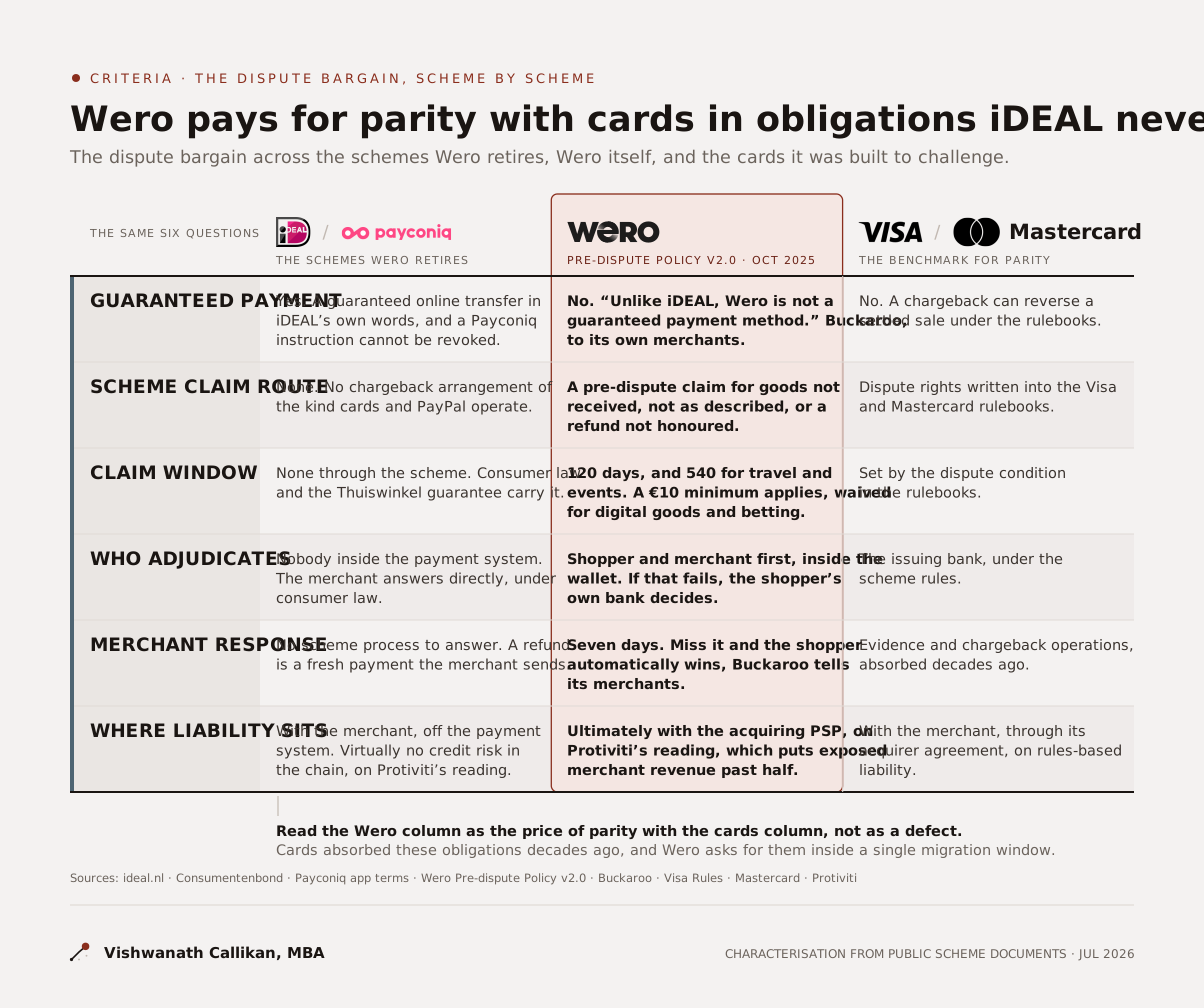
Under the schemes Wero replaces, the merchant’s position was clear. An iDEAL payment could not be reversed through the scheme, because there was no chargeback arrangement of the kind cards and PayPal operate, and a buyer with a problem pursued the merchant directly, under consumer law and schemes like the Thuiswinkel guarantee, rather than through the payment system. Payconiq’s terms are built the same way. The payment settles as a SEPA credit transfer, the user cannot revoke the instruction once authorised, and a refund is a fresh payment sent from the merchant’s side rather than a reversal the scheme imposes.
Wero’s eCommerce proposition changes that position. Its Pre-dispute Policy gives consumers a claim path for goods not received, not as described, or refunds not honoured. The window is 120 days from the transaction as standard, stretching to 540 days for travel and event sectors, with a €10 minimum that is waived for sectors including digital goods and betting. The claim starts as a structured conversation between shopper and merchant inside the Wero wallet experience, where the merchant’s PSP participates in the early-resolution programme, which is itself still phasing in. If that conversation fails, the shopper’s own bank adjudicates, and it can reimburse the shopper and then pursue the dispute onward to the merchant’s PSP.
Buckaroo tells its merchants what this means operationally. Respond to a dispute within seven days or the shopper automatically wins!
I would expect some PSPs to consider holding additional reserves against dispute exposure, and I would also expect Wero’s dispute fees to be passed on.
For a merchant who was promised a replacement for iDEAL, this is not a replacement, and it is understandable that merchants could feel aggrieved. It is a new dispute operation to stand up, staff to train, new response deadlines to hit, and a new category of revenue risk, all adopted under what should have been, for them, just a new shiny payment logo they accept.
Wero’s protections are a price worth paying in the long term
I should be clear that none of this reads to me as an EPI faux-pas. The protections are there because the contest Wero has entered demands them.
Card schemes carry dispute rights inside their rulebooks. Visa’s public rules define dispute conditions for merchandise not received and not as described. Mastercard describes the chargeback plainly as a rules-based mechanism for determining the financial liability of a disputed transaction, and merchants are bound to those regimes through their acquirer agreements.
However, the rail Wero rides cannot offer any of that natively. Under PSD2, a credit transfer cannot be revoked by the payer once received, and the SEPA Instant rulebook’s recall procedure is a limited bank-to-bank affair for duplicates, errors and fraud rather than a consumer right. Unauthorised payments are a separate matter, since banks already owe refunds for those under PSD2 whatever the rail. The gap is authorised payments that go wrong commercially. Whatever protection an A2A scheme wants, it has to build as an overlay.
And Europe has been explicit that the overlay is wanted. The Commission’s Retail Payments Strategy argued that instant payment services should offer features putting them on an “equal footing” with instruments that offer chargebacks. The BEUC warned that instant payments will “never flourish” without improved consumer protection. Wero’s disputes layer is that analysis and that strategic shift made operational.
The PSPs selling acceptance say as much themselves. Worldline markets the buyer-protection facility as a confidence feature. Mollie’s merchant guide is candid that buyer protection helps Wero compete with cards. Mollie, it should be said, appears on both sides of this argument, worried in the reporting and enthusiastic in its own guides, which feels about right for where the market is.
I would frame the new disputes layer not as a migration impediment to overcome but rather as the price of admission to the wider geopolitical contest Wero was created to enter.
Take the protections out and Wero becomes iDEAL with a different logo, comfortable for merchants and structurally unable to offer consumers what cards and PayPal already do. Keep them, and the acceptance side has to absorb obligations that the old schemes never asked of it. That is the tension, and it is real at both ends.
The pushback is precise, and it is not only merchants making it
It is worth being accurate about who is resisting, because the record is more specific than “merchants are grumbling”. The clearest documented clash came in March, when the FD reported retailers and payment firms colliding with the EPI over the iDEAL succession, and Adyen, Mollie and Buckaroo were among those said to fear higher costs, lengthy complaint procedures and more purchase fraud.
Owen Roderik Strijland and Ellen Straus of Protiviti had already laid the groundwork with their analysis. It shows that under Wero the ultimate financial risk in the chain rests with the acquiring PSP, where iDEAL carried virtually no credit risk, and on their estimate the share of merchant revenue exposed to credit risk could rise to more than half. Reserves, delayed payouts and stricter acceptance criteria sit amongst the many possible consequences.
The merchant associations, by contrast, are negotiating rather than revolting. Thuiswinkel.org, the Dutch eCommerce body, asks for transparent conditions, clear dispute rules and protection against abuse. Germany’s HDE aims its criticism at the cost of acceptance rather than at the dispute model.
When you peel back these layers of grumblings, a pattern shows up in who is saying what. The parties who will hold the financial risk (the PSPs, per Protiviti’s analysis) are the loudest, and the parties who will run the new processes (the merchants) are conditional. I doubt there are many voices on record that actually want Wero to fail, but nearly all of them are asking the reality-check question, which is what it costs to say yes.
The EPI has blinked once, but will it blink again?
On 15 July the EPI published the next phase of the iDEAL migration roadmap, under which every Dutch issuing bank connects from October 2026. Full migration is targeted for the end of 2027, and Purchase Protection arrives last, with full coverage now an objective for 1 January 2028. Dutch trade press reports that eCommerce merchants have until the end of 2028 to implement it.
Alongside the timing comes a pricing commitment. Wero scheme pricing stays broadly aligned with current iDEAL levels until 31 December 2028. The EPI’s Dutch country lead Ivo Broeren was straightforward about the sequence, confirming the original plan was October 2026 and that the deferral came after alignment with the market.
The EPI moved the dates and left the bargain intact
The figure is wider than a phone screen. Scroll it sideways, or use expand.


EPI buys iDEAL and Payconiq
The EPI acquires Currence iDEAL and Payconiq International, buying the acceptance base it now has to migrate.
I read that as the EPI negotiating in good faith, and it deserves to be recognised as a genuine compromise, a strong signal that the EPI listens to stakeholders on the acceptance side of the payments equation. But look at what changed and what did not. The dates moved, but the substance of the model (who adjudicates, what evidence counts, where liability lands, what disputes cost and how abuse is policed) is exactly where it was in October’s policy.
A compromise that keeps the protections is available to the EPI
Here is my read on what a compromise could look like, and I would put it no stronger than a direction of travel.
For starters, the instruments already exist inside the EPI’s own design. The Pre-dispute Policy already differentiates by sector, giving travel and events a 540-day claim window and dropping the minimum for digital goods. That is the template. Proportionate treatment by sector, on evidence standards, on claim windows and on fees, is how a scheme tunes the burden without abandoning the standard. It is also a very different thing from PSPs excluding riskier sectors from acceptance altogether, which is where the Dutch reporting warns the market could drift (although I doubt that would transpire).
Second, build the abuse defences merchants can see. The Protiviti analysis and the FD reporting converge on the same anxiety. It is not that consumers stand to gain protections, but that first-party misuse becomes a cost of acceptance. Card schemes have spent decades refining evidence standards for exactly this problem, and Wero can inherit that learning rather than relive it. The acid test is whether the cost of policing abuse lands on the party best placed to police it.
What the EPI cannot do is trade the protections away. Real asymmetries remain, and French and Belgian account holders cannot raise commercial pre-dispute claims at all, so coverage is uneven by design today. Those should resolve towards full protection rather than away from it.
The consumer standard is the entire justification for asking merchants to carry new obligations in the first place. Surrender it, and Wero has imposed the costs of a card scheme while abandoning the parity that made those costs worth paying!
Sovereignty by scale needs to be earned twice for Wero
We know that Wero’s consumer base can be bought. The acquisitions, the bank distribution and the co-branded migration are all reach that money and governance could assemble, and I have written before that habit is the part the EPI has to earn.
The disputes negotiation is the acceptance-side version of the same lesson. Visa and Mastercard enjoy their protections not because merchants love them but because the obligations were absorbed decades ago, priced in, and offset by a scale that nears ubiquity, which most merchants cannot refuse. The EPI is asking European merchants to absorb an equivalent bargain in a single migration window, at a scale it is still building. Some friction here is, if anything, to be expected, and it should not be read as a sign the project is faltering, because the friction is fundamental to the project.
Wero’s sovereign payment status was conceived at the acquisition table. For it to become a sovereign payment system that actually scales is what is being negotiated right now, in the form of dispute windows and evidence standards, and the outcome of that negotiation, not just the user count, is what will decide whether Europe has built a rival to cards or just a well-funded pale memory of one.